[2025 Edition] Is Thailand No Longer Cheap? Real Cost of Living and Tips for a Comfortable Life from a Local Resident
Moving overseas is gaining attention as a way to spend life after achieving FIRE (Financial Independence, Retire Early). Among the destinations, Southeast Asia is particularly popular due to its perceived low cost of living and easy access to Japan.
I have lived in Thailand for a full seven years, and I have personally experienced the benefits of its low cost of living and ease of life.
However, with the recent depreciation of the Yen, this aspect of "affordability" has become harder to feel. In the capital, Bangkok, the reality is that prices have risen to the point where one might wonder if it's no different from Tokyo.
Therefore, in this article, I would like to explain the current prices in Bangkok, Thailand, where I live, and the cost of living required to live comfortably there.
(For details on the initial costs of moving overseas, please refer to my previous article below.)

The Relationship Between Rising Prices in Thailand and the Weak Yen
Before explaining the prices of daily necessities, I want to briefly explain the background of why Thailand is said to be "not cheap anymore."
The reason I feel that prices in Bangkok are not much different from Tokyo is related to Thailand's inflation rate and the depreciation of the Yen.
Below, I explain the trends in inflation rates and exchange rates for both Thailand and Japan.
Trends in Inflation Rates: Thailand vs. Japan
[Thailand's Consumer Price Index (CPI)] (Source: Thailand Consumer Price Index (CPI) YoY)
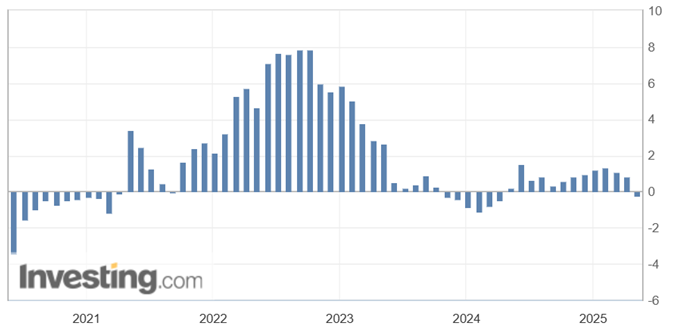
Looking at Thailand's CPI over the past five years starting from 2025
inflation peaked in 2023, and the subsequent rise has been moderate. As of May 2025, it turned negative for the first time in about eight months.
[Japan's Consumer Price Index (CPI)] (Source: Japan National Core Consumer Price Index (CPI) YoY)
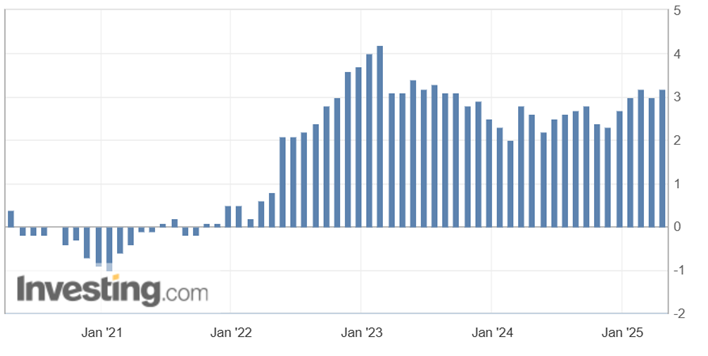
On the other hand, Japan's CPI has continued to rise from 2023 to the present.
Looking only at the short term, it might seem that Japan has a higher inflation rate than Thailand. However, when comparing the rate of increase over the past five years, it can be said that Thailand has had a higher rate of price increases than Japan.
The Impact of the Accelerating Weak Yen
While it is becoming harder to feel the cheapness of goods in central Bangkok due to inflation, the impact of the accelerating depreciation of the Yen adds another layer of difficulty.
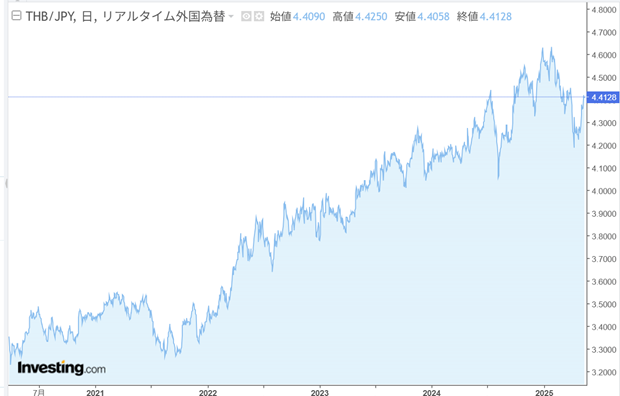
(Source: THB/JPY Real-time Chart - https://www.google.com/url?sa=E&source=gmail&q=Investing.com)
Looking at the price trend of the Baht over the past five years from 2025
Around 2020-2021, it hovered around 1 Baht = 3.5 Yen. However, from around 2024, it exceeded 4.0 Yen, and as of May 2025, it is hovering between 4.3 and 4.5 Yen.
This represents an increase of about 35%. For those living on Japanese Yen, this has the same impact as prices rising by 35% over the past five years.
Personally, since I earn income in Thai Baht and spend it within Thailand, I am not significantly affected. However, for expatriates paid in Yen or freelancers living in Thailand while working remotely for Japanese clients, this is likely a significant blow.
Real Price Survey in Bangkok, Thailand
From here, I will summarize my survey of real prices in Bangkok.
I will introduce the average price ranges divided into the following categories:
- Groceries & Daily Necessities
- Dining Out (Thai Food / Japanese Food)
- Rent
- Utilities & Communication Costs
- Transportation Costs
Note: The exchange rate to Japanese Yen is calculated at 1 Baht = 4.4 Yen (approx. $1 USD ≈ 34 Baht for reference) based on the rate on the writing date.
Also, the prices introduced are average prices, not the lowest possible prices.
Groceries & Daily Necessities
The average prices of groceries and daily necessities sold in Thai supermarkets are as follows:
| Item | Thai Baht (Japanese Yen) |
| Water (500ml) | 10 baht (44 yen) |
| Chicken (100g) | 20 baht (88 yen) |
| Onion (1 piece) | 20 baht (88 yen) |
| Beer (350ml) | 50 baht (220 yen) |
| Toilet paper (6 rolls) | 90 baht (396 yen) |
| Laundry Detergent (800g) | 60 baht (264 yen) |
| Shampoo (380ml) | 160 baht (704 yen) |
While many food items are cheaper than in Japan, daily necessities required for everyday life give the impression of being about the same price or slightly more expensive than in Japan.
Dining Out (Thai Food / Japanese Food)
When eating out, Thai food is cheap, but Japanese food feels about the same as or slightly more expensive than in Japan.
Also, even for Thai food, prices differ significantly between everyday food courts/stalls and air-conditioned restaurants.
Let's compare prices by type of establishment:
- Street Stalls: 40–60 THB (176–264 Yen)
- Food Courts / Canteens: 60–100 THB (264–440 Yen)
- Restaurants: 100–200 THB (440–880 Yen)
Incidentally, if you have a drinking party at a local Thai shop at night, the market rate is about 500 THB (2,200 Yen) per person.
For Japanese food, options like stalls or food courts are extremely rare, so it is uncommon to eat for under 100 THB.
Set meals (Teishoku) cost 250–300 THB (1,100–1,320 Yen), and Ramen or Soba are generally in this price range as well. This is not much different from the price of lunch in Tokyo.
If you go to a Yakiniku restaurant or Izakaya and drink alcohol, the budget will be around 2,500 THB (11,000 Yen) per person, which feels slightly more expensive than in Japan. However, since Japanese food is "foreign cuisine" in Thailand, this is unavoidable.
Rent
Next, let's look at rent.
Depending on the size of the property, it is sometimes said that rent in Bangkok is not much different from Tokyo.
Therefore, for people from rural areas of Japan, this might be a point where they don't feel the "cheapness" of living abroad.
The average rent by layout in Phrom Phong, where many Japanese live, is as follows:
- 1 Bedroom (1LDK): 25,000–40,000 THB (110,000–176,000 Yen)
- 2 Bedrooms (2LDK): 50,000–80,000 THB (220,000–352,000 Yen)
- 3 Bedrooms (3LDK)+: 70,000 THB+ (308,000 Yen+)
Since Phrom Phong is a comfortable area for Japanese people, the market rent is higher compared to other areas, with a minimum of around 100,000 Yen.
Most Japanese living around here are expatriate families whose rent is subsidized by their companies.
For compact layouts suitable for singles or more affordable properties, the market rate for a 1 Bedroom (1LDK) would be around 15,000 THB (66,000 Yen).
(For recommended residential areas for singles and immigrants, please refer to the following article.)
Utilities & Communication Costs
Utilities and communication costs tend to be cheaper than in Japan, but it depends on usage.
For a single person living in a condominium, the monthly costs would generally be around these figures:
- Water: 100 THB (440 Yen)
- Electricity: 1,000 THB (4,400 Yen)
- Internet: 500 THB (2,200 Yen)
- Mobile Phone: 500 THB (2,200 Yen)
One surprising thing about life in Thailand is the cheapness of water bills. In the past five years,
my water bill has never exceeded 100 THB a month.
Internet and mobile phone costs also feel cheaper compared to Japan, but since low-cost SIMs have become widespread in Japan recently, the difference may not be drastic.
Transportation Costs
The main public transport in Bangkok includes trains (BTS/MRT) and public buses, as well as taxis and motorcycle taxis.
There are also local vehicles like Tuk-tuks and Songthaews, but since few foreigners use them for daily commuting and there is no comparison in Japan, I will omit them this time.
| Item | Starting fare |
| BTS (train) | 16 baht (70.4 yen) |
| MRT (Subway) | 16 baht (70.4 yen) |
| Local bus (no air conditioning) | 10 baht (44 yen) |
| Local bus (with air conditioning) | 15 baht (66 yen) |
| Taxi | 35 baht (154 yen) |
Compared to Japan, all transportation feels significantly cheaper.
Especially taxis cost around 1,000 Yen even for an hour-long ride, so even if you drink too much and miss the last train, you won't shudder in fear at the fare.
Comfortable Living Cost in Thailand: 150,000 Yen+ Per Month
Taking into account the prices explained so far, I calculated the monthly living expenses.
| Item | Starting fare |
| Food expenses | 15,000 baht (66,000 yen) |
| Daily necessities expenses | 1,500 baht (4,400 yen) |
| Rent | 15,000 baht (66,000 yen) |
| Utilities & Communication Costs | 2,100 baht (9,240 yen) |
| Total | 33,600 baht (147,840 yen) |
*(Note: Food costs are calculated assuming an average of 500 THB per day, mixing Thai and Japanese food.)
It turns out that about 150,000 Yen (approx. $1,000 USD) is necessary to live comfortably without strain.
Since this assumes life after FIRE, transportation costs are omitted from the table, assuming you won't be commuting daily by train or taxi like a salaryman.
Incidentally, the above is the amount to "live comfortably without strain," not to "live luxuriously and have fun."
" For those who want to drink heavily at Izakayas every night, play golf every week, or frequently visit karaoke and nightclubs, this amount will not be nearly enough.
If you are considering moving to Thailand after FIRE, I recommend simulating what kind of life you want to lead in Thailand and building sufficient assets based on that assumption.
Summary
I have summarized the prices in Thailand in detail. How did you feel about it?
Prices in Bangkok are by no means cheap, and living in the countryside in Japan might actually be cheaper in terms of living expenses.
With the Yen depreciating in just five years, prices in Southeast Asian countries, not just Thailand, continue to rise gradually. Therefore, similar phenomena may be occurring in any country that has been said to have low prices until now.
For those currently building assets for overseas migration after FIRE, I strongly recommend re-investigating the prices and living costs of your planned destination and re-calculating the necessary expenses.
Author: Yuki Ishida
Writer based in Thailand
In 2017, I fulfilled my long-cherished desire to move to Thailand and have been working as a sales and career consultant at a Japanese staffing company there.
I began my activities as a writer in 2019 and mainly share information useful for living in Thailand and moving abroad through both domestic and international media. Based on my own experience of relocating overseas, I strive to provide realistic information to help those planning to move abroad avoid regrets, and I write with this motto every day.
The media I have contributed to so far are not limited to Thailand-related topics, but also cover a wide range including domestic and international travel, local governments, food manufacturers, and educational institutions.