[True Story] Tokyo Real Estate "Rhapsody" in the Reiwa Era
A Heartbreaking "Love Letter" in the Mailbox
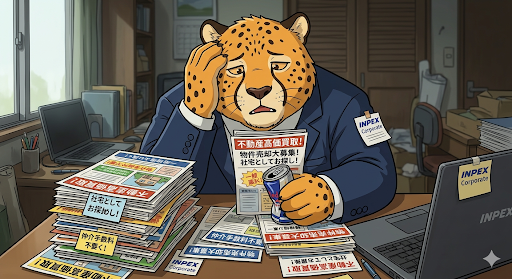
Today again, the mailbox of my office is bulging as if defying gravity. What is overflowing is neither a utility bill nor a letter from a dear friend. It is a mountain of flyers—a desperate courtship from real estate agents, so-called "agents," pleading: "Please sell your property."
Today again, the mailbox of my office is bulging as if defying gravity. What is overflowing is neither a utility bill nor a letter from a dear friend. It is a mountain of flyers—a desperate courtship from real estate agents, so-called "agents," pleading: "Please sell your property."
He is right. Currently, the real estate market in central Tokyo is in an abnormal state of "extreme hunger."
Tripled in 10 Years. The "Fever" of a Distorted Market
There is a studio apartment in Tokyo that I acquired about 10 years ago. At that time, it was about 7 million JPY—a high-quality "Spring" that generated solid cash flow. But look what's happening now. Some of the flyers I've been receiving recently are advertising it for about three times the price I paid for it.
The investment triples in 10 years. Hearing only this, an inexperienced investor would dance for joy and hit the sell button. However, I do not interpret this phenomenon as "me being popular." This is evidence that the Japanese real estate market is decisively "distorted."
They are chasing "numbers." But I am protecting the "Asset (Spring)." The vision of the pursuer and the owner are fundamentally different.
Disgust for Agents Who Forgot "Shippo-Yoshi" (Four-Way Good)
The reason these flyers and calls trouble me is not simply because they are "persistent." It is because their business is furthest from the "Shippo-Yoshi" that I believe in.
They whisper sweet words like "You can sell high," but what they are really aiming for is earning commissions through resale. Since that is their job, it is only natural, but...
The properties they forcibly buy at high prices have the dealer's profit added on top and are passed to the next "sucker."
Those who are made suckers are often serious office workers who have just started investing. Studio apartment dealers team up with banks and whisper: "It will save you taxes," "The monthly out-of-pocket expense is minimal," "It serves as a substitute for life insurance." These are their classic cliches.
The traps that elite salarymen fall into
The "good attributes" of employees at large corporations or civil servants are originally the strongest weapons for building wealth through leverage. However, for those without knowledge, it can become the "strongest chain" that binds them.
How can you become economically independent with a negative monthly cash flow? While they hold deficit properties and rejoice over a small tax refund from loss-offsetting, they fall into being "slaves who cannot quit the company." The real estate agent runs away once they sell, and the bank holds the collateral. The only ones carrying the risk completely naked are the salarymen who have been forced to take the risk of personal bankruptcy.
Knowing "What is a Real Asset?"
In my common sense, "Anything with a negative monthly cash flow is not an Asset. It is a Liability."
If real estate prices continue to hit new highs, they might not get seriously hurt. But that is "Only God Knows."
During the former bubble era, everyone thought real estate would go up forever. Everyone knows the bubble burst that happened afterward. It led to Japan's long stagnation.
Summary: Do Not Rush
I think the current real estate prices in Tokyo are overpriced. To overseas investors and "heady" elites who do not know the reality, I want to say clearly: "Even if you invest in Tokyo real estate now, you cannot get sufficient cash flow. Because the price is abnormally high."
Whether in stocks or real estate, the moment you buy at a high price, the risk of that investment increases. You could say there is little room to keep up with market changes, and little room to escape.
What is necessary to build wealth is not the speed of following trends. It is a strong "will to wait," refusing to listen to the rhapsody of a distorted market. Do not rush.
▪Disclaimer
The information provided on this blog is for educational and informational purposes only and does not constitute professional financial or investment advice. We do not provide third-party asset management or individual management services. Please make investment decisions at your own risk.
■Author Profile
About the Author Kenji Kamioka
AFP (Certified by the Japan Association for Financial Planners), Licensed Real Estate Transaction Specialist
President and CEO of Julius Co., Ltd.An investor and strategic media owner with over 10 years of business management experience in three Asian countries: China, Thailand, and Vietnam. While actively managing real estate and financial assets through his own company, he promotes a lifestyle that leverages the structure of capitalism. He has authored numerous books.
▶ [Click here for author profile details.]
▶ [See the list of works here]