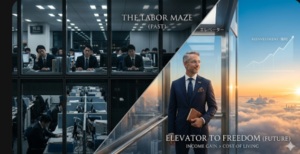
Is the "Land of Smiles" No Longer Cheap? The Reality of Capitalism Felt in Bangkok After a Long Absence (Part 2) (Subtitle: Unchanged Traffic, Changing Prices, and the Necessity of Asset Management)
The Nostalgic Traffic Jams of Sukhumvit Sois
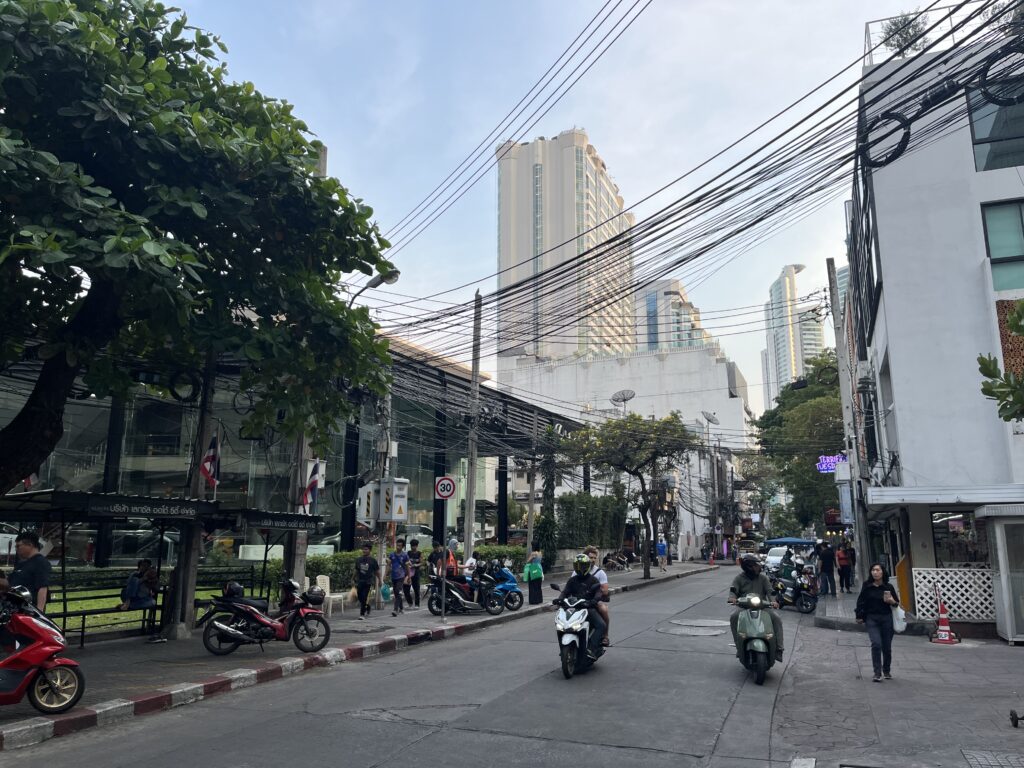
During this stay in Bangkok, I intentionally traveled through the "Sois" (side streets branching off the main road) of Sukhumvit. This is the area between Soi 49 and Soi 23, where many Japanese residents live.
It has been a very long time since I viewed this scenery from a car window since my days as an expat. Memories of being impatient in a stationary car and hurrying the driver to avoid being late for a business dinner came flooding back. The main Sukhumvit road is brightly lit, but once you enter a Soi, the streetlights become sparse, and a unique dimness prevails.
As it was a Friday night, the cars were at a complete standstill as usual. I couldn't help but chuckle at the classic Thai irony: "Entering a shortcut to avoid main road traffic, only to find it completely non-functional." "Ah, this very irrationality is what makes it Bangkok," I thought, feeling strangely nostalgic.
Realizing the Magic of "Prik Nam Pla" at a Street Stall
For lunch, I ordered Khao Pad (Thai fried rice) at a street stall in an alley. The price was 65 baht. Water was 5 baht. A total of 70 baht. This is likely the "standard" price setting in today's Bangkok.
From a worn-out container on the table, I poured the familiar "Prik Nam Pla" (fish sauce with chopped chili peppers). The saltiness of the fish sauce and the kick of the chili hit the fluffy rice, striking the brain directly. This is, again, incredibly delicious.
I love this condiment so much that I end up adding too much. In Thai restaurants in Japan, they often don't have this Prik Nam Pla, or in worse cases, they say it's an "extra charge," which is disappointing.
Amidst the hustle and bustle and the humid heat of the stall, I felt like Goro Inogashira from the drama "The Solitary Gourmet" and devoured the Khao Pad. It was the moment my stomach completely regained its memories of Bangkok.
Unchanged Safety, the Unchanged "Smile," and the "Farangs"
Walking through the city, I was struck once again by the overwhelming safety. Whether 20 years ago or now, I never feel a sense of physical danger. The character of the Thai people, known as the "Land of Smiles," is also alive and well. Putting my hands together and exchanging a "Sawatdee Kap" (hello) brings back a warm smile. The feeling of time flowing slowly throughout the city is just as it was. This comfort is likely the biggest reason why Japanese people are attracted to Thailand.
Also, in the urban areas of Bangkok, "Farangs" (Westerners) are as numerous as ever. Climate, prices, and culture—for them, Thailand remains an attractive option to enjoy life to the fullest.
Bangkok as a Place to Live: Expanding Residential Areas and "Abnormal Japan"
In the past, the eastern limit of the Japanese residential area was around Soi 55 (Thong Lo). However, the BTS (Skytrain) has now extended, and I hear that expats are living even beyond On Nut, which used to be the terminus.
In central areas like Asoke, rent is not much different from Tokyo. However, if you move slightly away from the center, you can live comfortably in a condo with a pool and gym that is far larger than anything imaginable in Tokyo. For someone like me who hates the cold, this warm climate is heaven. (Though the "Southeast Asian classic" of air conditioning being murderously cold in rooms and trains is also alive and well.)
Here, I must mention "prices," which many Japanese people are concerned about. The impact of the weak yen is certainly significant.
- Lunch in the old days: 30 baht x approx. 3 yen = 90 yen
- Lunch today: 60 baht x approx. 5 yen = 300 yen
It's more than triple when converted to Japanese yen. It's no wonder people feel it has become "expensive." However, please think calmly. I was an expat about 20 years ago. After 20 years, it is "natural" for prices to rise along with economic growth from a global perspective. Rather, it is "Japan that was abnormal," where deflation continued throughout the 30 years of the Heisei era, and neither wages nor prices rose. Fortunately, Japan has finally shown signs of escaping that spell recently, but the gap with the world is clear.
Verification: Is it Possible to "Escape" Overseas with "Japanese Yen Savings"?
In the past, there were three reasons why I thought Bangkok was wonderful.
- Metropolitan yet cheap cost of living
- Food is cheap and delicious
- Safe and secure
Based on the current exchange rate and Japanese price standards, the merits of 1 and 2 are already fading. However, as long as you earn and live in local currency (Baht), there is no need to worry excessively about exchange rate fluctuations. Including the pro-Japanese national character, it remains an easy country for Japanese people to live in.
However, I must tell you one cruel truth. The model of "moving to a cheap country with only the Japanese yen (cash) saved for retirement" will completely collapse in the future. In a trend where the value of the Japanese yen continues to fall relatively and funds dwindle, simple "savings" are nothing more than a risk.
Conclusion: A "Mandatory Subject" for Hacking Capitalism
That is why we must learn "asset management." Not relying solely on Japanese yen savings, but owning assets that generate income (such as stocks and real estate) and creating a system where money works for you. This is not limited to those living overseas. It is the same for those living in Japan; it is a "mandatory subject" for surviving in 21st-century capitalist society.
Amidst the heat and traffic of Bangkok, I was reaffirmed. I felt the correctness of my own investment doctrine—building a multi-layered asset structure and creating a self-sustaining fountain of wealth. As long as this country continues to grow, I, too, will continue to run, converting that energy into assets.
▪Disclaimer: Warning Regarding Investment Risks The information provided on this blog is for educational and informational purposes only and does not constitute professional financial or investment advice. Please make final investment decisions at your own risk.
[Profile]
About the Author Kenji Kamioka
Strategic Media Owner & Asset Holder | President and CEO of Julius Co., Ltd.
A practitioner of "Creative Investment" who transforms real-world experience into digital assets. With over 20 years of management experience, including a decade of corporate leadership across Thailand, Vietnam, and China, he now operates Julius Co., Ltd. His focus lies in proprietary asset management and the development of the "CHITA" AI-character IP. His mission is to empower individuals to reclaim their sovereignty through capitalist philosophy. "Investment is a practical subject—the only way to learn is to move the capital yourself."
AFP (Certified by the Japan Association for Financial Planners), Licensed Real Estate Transaction Specialist
Message from the Author
"No work in life is ever in vain." My over 20 years of corporate leadership and my time stationed across Asia are the nourishment for who I am today. By leveraging the flow of the AI era as an ally, I aim to transform society into something more prosperous and engaging. Julius Co., Ltd. combines a child-like sense of playfulness with the discipline of adult experience to ride the torrent of the AI era.
[My Doctrine of Success (The Laws of the Universe)]
Guiding principles for life and wealth, derived from 11 years in Asia and decades of investing.
- Life is meant to be enjoyed: Don't grind at 100%. Success comes when you operate with 30-40% reserve power.
- Give to receive: Always ensure the other party gains. True success is a "Four-Way Win."
- Bless others' success: Jealousy blocks wealth. Celebrating others brings fortune back to you.
- Adversity is Opportunity: When things go wrong, look closer. That is where the hidden clues for success lie.
- Nothing is wasted: There is no such thing as "working for free." All experiences connect to your future success.
Book
❶『令和のサラリーマンの為のFIREのススメ』(Amazon電子書籍)
❷『FIRE Recommendation for Office Employee』(Amazon Kindle)