Geographic Arbitrage Strategy: How to Separate Wealth Generation from Consumption for FIRE
"The era of earning a living while being worn out on crowded trains is over." "What are the requirements for designing a fulfilling life plan in countries and regions with low cost of living?"
1. Introduction: Two Macro Distortions That Accelerate Wealth Accumulation
Let me be completely honest. My attainment of financial freedom and transition to an asset owner was not due to some extraordinary personal talent. It was simply because I recognized two massive macroeconomic "distortions" (arbitrage opportunities) early on and deployed all my resources into them.
- Geographic Arbitrage (Spatial Distortion): Capitalizing on strong currencies while living in low-cost-of-living regions during my executive expat years in Bangkok, Thailand, and Ho Chi Minh City, Vietnam.
- Deflationary Real Estate (Temporal Distortion): Acquiring prime real estate at the absolute bottom cycle during the final stages of Japan's deflationary era, when asset values were severely underpriced.
The entire equation boils down to a single question: "Did you have the financial vessel (Seed Money) ready to ride the macro wave when it arrived?" Most people stand in the middle of these distortions without ever realizing they exist, or they spot them too late and watch the wave pass because they lack the capital. I dedicated my executive expat years—a period I call the "macro bonus time"—solely to constructing that initial, solid block of cash.

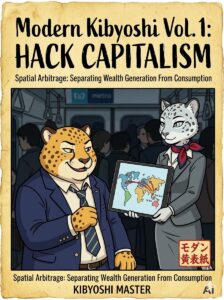
👉Kindle EditionModern Kibyoshi Vol. 1: Hack CapitalismDiscover the complete story。
2. Violent Asymmetry: Hacking the Salary Operating System
In the realm of wealth architecture, the sheer scale of your initial seed capital constitutes absolute justice.
- If you manage a 1-million-yen portfolio at a 10% compound rate, you generate a mere 100,000 yen a year. Your daily life remains completely unchanged.
- If you manage a 100-million-yen portfolio at a 10% compound rate, you harvest 10 million yen a year. Your entire life completely transforms.
The ultimate challenge is engineering that block of capital as rapidly as possible during the initial phase. Back then, a plate of Gapao rice at a Bangkok street stall cost around 100 yen (30 Baht), and a premium massage was just 500 yen an hour. This stark asymmetry—receiving a developed-nation salary (Japanese Yen) while consuming at emerging-market costs—creates an unbeatable cash flow engine. During this period, I avoided taking uncalculated investment risks. I focused entirely on pooling the excess liquidity bleeding from this spatial distortion, ruthlessly stockpiling overwhelming ammunition (seed money).
3. Modern Digital Arbitrage: The Tokyo-to-Rural Migration Protocol
Those who complain that arbitrage is no longer viable due to the historic depreciation of the Yen are completely blind to the map right in front of them. In this modern era democratized by remote work and generative AI, average business professionals hold the ultimate opportunity to play the "Geographic Arbitrage" card.
If you turn your gaze domestically, you will find a violent structural imbalance between Tokyo (hyper-dense, high-cost) and rural regions (underpopulated, low-cost).
I know of a certain corporation where, following a total transition to remote work, employees migrated to spacious, detached properties in rural areas. Because of the physical distance, unproductive corporate political drinking sessions evaporated, and both time-based friction and relationship management costs were completely purged.
- Income Protocol: Tokyo Benchmark (Maximization)
- Expense Protocol: Rural Benchmark (Minimization)
On one hand, you have a life confined to a cramped, expensive studio apartment in Tokyo with a 100,000-yen rent, where your mental health is eroded by packed commuter trains and 5,000 yen is wasted every single night on hollow social obligations. On the other hand, you have a life in a vast rural estate with a 50,000-yen rent, soaking in natural hot springs after work, and enjoying the finest, freshest local ingredients at a fraction of the cost. It requires no calculation to see which choice is substantially "wealthier," and which infrastructure automatically generates the seed money for compound interest.
4. Purging the Legacy OS and Redefining the "4% Rule"
The solitary barrier to executing this strategy is the archaic, centralized fixed mindset—the Legacy OS—that dictates you cannot survive unless you are physically chained to a corporate headquarters in Tokyo.
If your organization believes that "visibility equals performance," you simply need to leverage AI to sharpen your skills to a level where the absolute quality of your deliverables silences any objections. Any complaints about rural infrastructure being inconvenient have already been rendered flat and obsolete by Amazon and global digital networks that reach the ends of the earth.
If you can optimize your living expenses by half through physical "mobility," the time required to reach financial independence (FIRE) is mathematically cut in half. Doubling your annual salary through sheer individual effort is an uphill battle, but shifting your coordinates to slash your costs by 50% is achievable tomorrow through a single executive decision.
According to standard FIRE theory (the 4% rule), maintaining a monthly living expense of 200,000 yen requires roughly 60 million yen in financial assets. However, if you utilize geographic arbitrage to optimize your monthly expenses down to 100,000 yen, the required asset threshold rewriting your system drops to a mere 30 million yen. The moment a thinker wakes up to this "Law of Potential Capital Energy," the bars of the rat-race cage dissolve entirely.

5. Conclusion: Navigate the Capitalist Ocean via Potential Energy
When you discover a distortion in the macroeconomy, do not merely consume it as passive news; write it directly into the requirements definition of your personal life plan.
Hack capital by utilizing Tokyo's robust corporate credit and your day-time institutional reliability as a professional (Day Face), and maximize your wealth circulation efficiency by optimizing your coordinates for living and investing (Night Face).
"Chita," the character who appears on my blog, stands amidst the suffocating noise of Tokyo's packed trains, yet he glares at the pioneering maps of local regions and Asian expansion routes displayed on his sleek tablet with a sharp, knowing smirk. He does so precisely because he holds the ultimate golden ticket to victory: the mastery of spatial arbitrage.
There is absolutely no need to desperately run up a descending corporate escalator. Identify the distortion, capture the macro wave, and execute your mobility intelligently.
▪Disclaimer
The information provided on this blog is for educational and informational purposes only and does not constitute professional financial or investment advice. We do not provide third-party asset management or individual management services. Please make investment decisions at your own risk.
© 2026 Julius.inc / Kibyoshi Project. All Rights Reserved.
"This character and setting are the intellectual property of Julius Inc., based on its own doctrine."
■Author Profile
About the Author Kenji Kamioka
AFP (Certified by the Japan Association for Financial Planners), Licensed Real Estate Transaction Specialist
President and CEO of Julius Co., Ltd.An investor and media owner with over 10 years of business management experience in Asian countries: Thailand, and Vietnam. While actively managing real estate and financial assets through his own company, he promotes a lifestyle that leverages the structure of capitalism. He has authored numerous books.
▶ [Click here for author profile details.]
▶ [See the list of works here]