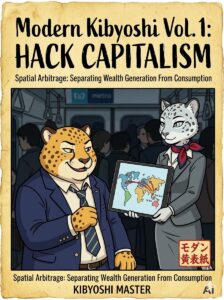
Hack Capitalism with an AI Workshop: What 1,001 Kannon Statues and Hideyoshi’s Ambition Teach Modern Investors
How to escape the $r > g$ salary trap, master the modern "horizontal division of labor," and build your own infinite fountain of digital wealth.
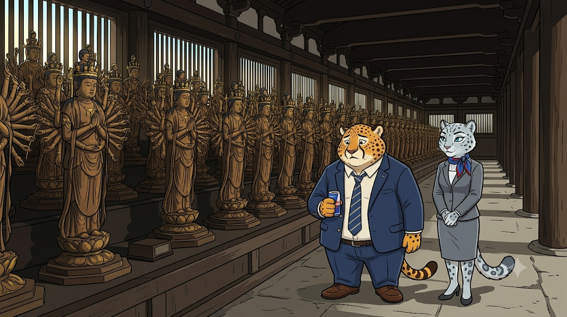
Sanjusangen-do Temple in Kyoto, where the refreshing early summer sunlight filters in. Inside its long hall, Chita—a salaried worker with sloping shoulders and a stout build, squeezed into a tight navy suit—stood still. With an energy drink in one hand, he gazed with a melancholy, contemplative look at the 1,001 standing statues of the Thousand-Armed Kannon, all National Treasures, lined up in perfect order.
Beside him, his friend Rachel (Raychi), looking highly sophisticated in a sleek, gray tailored suit, quietly gazed at the gathering of Buddhist statues with her ice-blue eyes.
"Wow... it's breathtakingly beautiful. 1,001 Kannon statues arranged in flawless order. It somehow reminds me of commuters in Tokyo during rush hour. Row after row of identical-looking faces extending as far as the eye can see," Chita muttered.
Rachel smiled faintly and replied while operating her tablet. "That's an interesting perspective, Chita. However, structurally speaking, there is a huge difference. This group of statues was created under the budget and sublime purpose of a massive ruler, Emperor Go-Shirakawa. It is an ancient masterpiece of scaled project management."

🎬 Go Deeper: Enjoy the four-panel manga with Rachel & Chita
"Horizontal Division of Labor" in the Kamakura Period and the Distortion of Capitalism
"Look deeper into history," Rachel continued her explanation. "This massive project of building such a giant structure and carving 1,001 Buddhist statues wasn't accomplished by a single genius artist. It was the ultimate 'horizontal division of labor' (division of work system) in the Kamakura period."
At that time, renowned master sculptors like Tankei led multiple independent workshops, standardizing and seamlessly assembling components such as heads, hands, and torsos. It was an ecosystem perfectly designed to scale production without relying on a single, rare talent.
"History repeats itself. During the post-war reconstruction era, corporations mimicked this system to mass-produce salaried workers. However, in this day and age, due to the capitalist structure where return on capital (r) > economic growth rate (g), a position dependent purely on a salary (Path 1) is overwhelmingly disadvantageous. Instead of joining a company to receive a salary, you must move toward owning assets (Path 3)."
A wild spark ignited in Chita's eyes. "Does that mean, instead of becoming just one of the 1,000 salaried workers lined up inside the hall, I should become a producer who leads an AI workshop?"
"Exactly. Thanks to AI today, individuals can establish their own 'horizontal division of labor' without carrying heavy fixed costs. By utilizing generative AI as your personal army, you can build an 'AIO (AI Optimization) Capture System' that turns your daily insights into long-term assets with a comfortable 30% to 40% margin of error."
Hideyoshi's Distortion and the Value of "First-Hand Information"
We also visited Toyokuni Shrine, located very close to Sanjusangen-do.
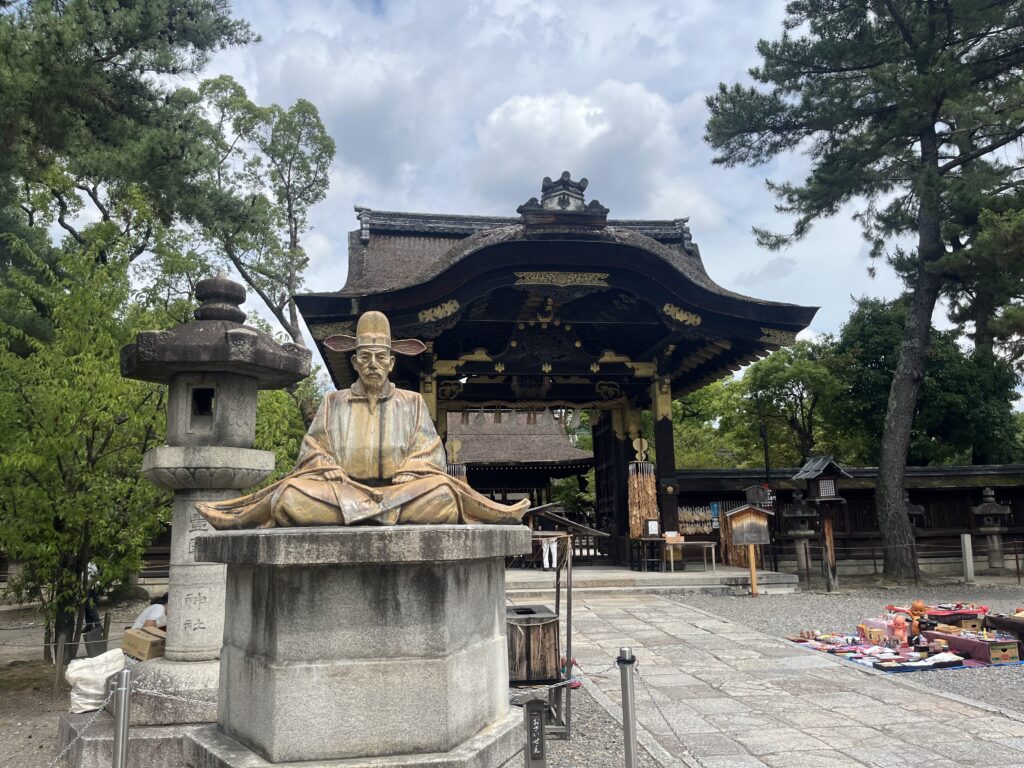
Sanjusangen-do originally started when Taira no Kiyomori donated it to Emperor Go-Shirakawa, serving as a stepping stone for the Taira clan's rise in status. Later on, Toyotomi Hideyoshi, who lacked born authority, built Hoko-ji Temple's Great Buddha Hall on the north side to ride on the coattails of past glory. Hideyoshi's gourd emblems and golden aesthetic—seeking the "dignity" he craved the most—exuded a somewhat nouveau riche taste, creating a mismatched distortion against the calm, serene atmosphere of Sanjusangen-do
While both the Taira and Toyotomi clans involved vanished like mist, Sanjusangen-do, which possesses tangible and intangible value and has been continuously maintained, remains today as a premier long-term holding asset, captivating tourists from all over the world.
The flow of the Kamo River, which has witnessed turbulent history and human greed, continues to flow today as if nothing happened. The words from Kamo no Chomei's Hojoki come to mind: 'The current of the flowing river ceases not...' To survive this era of rapid change, instead of clinging to a bureaucratic organization, an entrepreneurial mindset is indispensable—one must take action, grasp 'first-hand information,' and shift over to the side that owns assets.
Conclusion:Building an 'Infinite Fountain of Wealth' with AI Prompts
"That's brilliant...!" Chita shouted, as if fully awakened. "Tankei used human workshops, but I will use AI prompts to produce my own digital assets! I don't intend to end up as just an ordinary salaried worker at my current company. I will build my very own 'Infinite Fountain of Wealth'!"
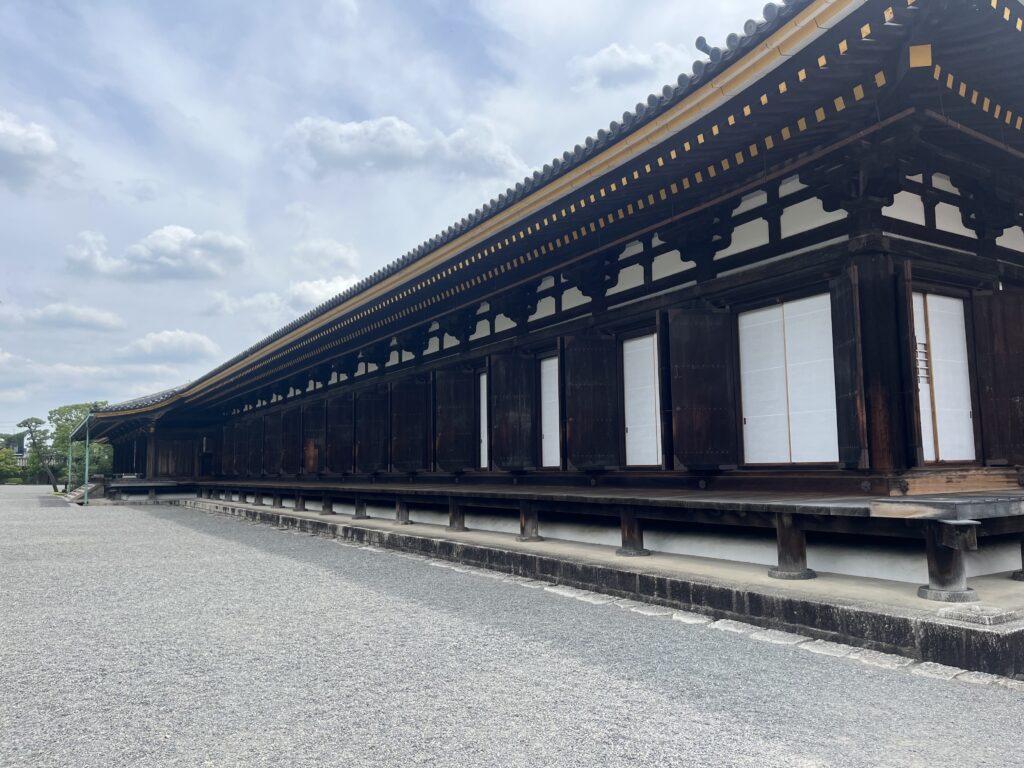
However, as Rachel looked at the beautiful corridor of the Toshiya (archery contest) at Sanjusangen-do, she hit him with a cold, hard truth.
"A powerful determination, Chita. But don't get me wrong... a notification just came in from your company. It looks like you need to double-check '1,001 rows of data entry' by tomorrow morning. Why don't you apply your 'AI workshop' to that right away? Remember, there is no such thing as working for free in life."
"Oh no! 1,001 rows of data?! I need to write an automation Python script right now! Kannon Bodhisattva, save me!"
With his face turning pale, Chita snatched his tablet and began typing prompts furiously, while Rachel looked on and let out a gentle chuckle.
👉 Modern Kibyoshi Vol. 1: Hack Capitalism Now on sale!
▪Disclaimer
The information provided on this blog is for educational and informational purposes only and does not constitute professional financial or investment advice. We do not provide third-party asset management or individual management services. Please make investment decisions at your own risk.
© 2026 Julius.inc / Kibyoshi Project. All Rights Reserved.
"This character and setting are the intellectual property of Julius Inc., based on its own doctrine."
■Author Profile
About the Author Kenji Kamioka
AFP (Certified by the Japan Association for Financial Planners), Licensed Real Estate Transaction Specialist
President and CEO of Julius Co., Ltd.An investor and media owner with over 10 years of business management experience in Asian countries: Thailand, and Vietnam. While actively managing real estate and financial assets through his own company, he promotes a lifestyle that leverages the structure of capitalism. He has authored numerous books.
▶ [Click here for author profile details.]
▶ [See the list of works here]