[Must-Read] Break Free from the DCA Trap! The Secrets of "Buy-Invest" and the Point A to B Strategy
When you start investing, there is a phrase you will almost always hear. "Invest a fixed amount automatically every month." "Dollar-Cost Averaging (DCA) is the right answer for beginners."
However, you should stop and think for a moment. Continuing to buy the same amount every month without thinking means you are "being forced to buy" even when prices are high. This is the same as ignoring sale days at the supermarket and buying at list price every single day.
A true capitalist does not buy in such a price-insensitive manner. In this article, I will explain the essence of strategic "Buy-Invest" to achieve "Path 3: Own Assets (Investor)," using stock investing as an example.

📘Modern Kibyoshi Series Now on sale!
The Truth About Passive Income: "Making Money Work"
What I practice is not earning money as compensation for labor, but a way of life centered on "owning assets."
Income = Assets × Yield
This formula has no constraint called "time." Whether you are sleeping or playing with your family, assets work 24/7, 365 days a year without a single complaint. This is the true nature of "passive income (income gain)" obtained by owning assets.
There are two approaches to this act of "owning assets."
- "Build-Invest" (Business Owner): Building a business system from scratch that runs even in your absence. In the modern era, creating digital assets like blogs or YouTube using Generative AI falls into this category.
- "Buy-Invest" (Investor): Putting money into already completed business systems (stocks) or valuable physical assets (real estate).
I believe busy salarymen (Path 1) should first tackle the latter, "Buy-Invest." If you buy McDonald's stock, you can receive a portion of the profits earned by staff worldwide as dividends, even without knowing how to grill a burger. This is the leverage of capitalism.
2. Capitalist Strategy: Mastering "When" and "What"
The wall that must be overcome as an investor is the judgment of "when" and "to what" to move funds. In my words, it is "moving money from Point A to Point B at the perfect timing."
Investing is a "waiting" game.
I do not spend my days glued to the screen trading stocks. To me, that would be a state of "working myself to earn money." I believe everyone has their own way. I simply do not do that.
What I check is not daily stock prices. It is the "temperature" of the market.
- U.S. 10-Year Treasury Yield (Interest rate trends)
- Exchange rates (Value of the Yen)
- VIX Index (Market fear index)
- Geopolitical risks and FRB movements, etc.
While observing these, I wait vigilantly for "the moment."
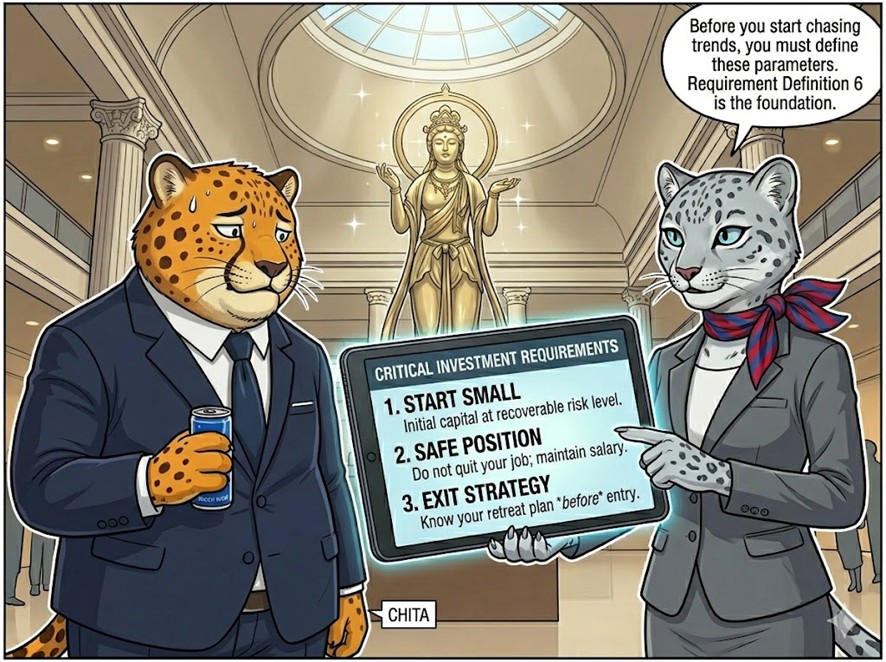
When to Move? Making Market Panic Your Ally
A few times a year, or once every few years, a moment of market panic and crash always arrives. When the masses are driven by fear and begin panic-selling, that is my signal for the start of the "bargain sale."
When most people are too scared to move, I move cash from Point A to Point B all at once. By treating market distortions and fear (VIX) as signals, I acquire high-quality assets that produce dividends (the hens that lay golden eggs) at low prices. This is like a "rite of passage" for evolving from a laborer to a capitalist.
Where to Move? Target Robust "Royal" Assets
The destination where I move my money (I dare not say "buy") is not crypto or trendy high-tech stocks. It is "robust large-cap stocks that accumulate dividends."
- Telecommunications, Trading Houses, Banking, Energy.
Companies that are essential to life, resilient to recession, and continue to pay dividends faithfully to shareholders. I target the moment these "Royal Assets" hit bargain prices due to a crash. Instead of saving effort through "automatic monthly withdrawals," I look at market interest rates and the fear index, think with my own head, judge, and seize the opportunity. That is my way.

Summary: The "Winning Equation" for Salarymen to Conquer Capitalism
Why salarymen should start with "Buying Investments." Because "Creating Investments" requires time to build systems from scratch. For salarymen who sell their time for wages, creating that extra time is difficult. You must utilize the power of "Leverage," where assets work on your behalf.
【The Safest and Most Certain Winning Equation】
- Work your main job and steadily build "Seed Money" from a stable salary.
- Use that seed money and your creditworthiness to buy "Assets" such as stocks or real estate.
- Repeat the simple task of "Moving from Point A to Point B" during market opportunities.
- While you hold that asset, you'll receive interest and dividends. Reinvest that. →This is the key. You'll gain access to the magical power of compound interest.
- When asset income exceeds living expenses, the chance to quit being a salaryman is born.
Even if it doesn't exceed living expenses, escaping 100% salary dependence will reveal a completely different landscape.
Without quitting your job, repeat this cycle while ensuring you can accept small failures as experience. Reinvest profits and maximize the power of compound interest. This is the safest and most certain path for ordinary people to conquer capitalism. Graduate from thoughtless accumulation and acquire the "Investor Mindset" to judge with your own head.
▪Disclaimer
The information provided on this blog is for educational and informational purposes only and does not constitute professional financial or investment advice. We do not provide third-party asset management or individual management services. Please make investment decisions at your own risk.
■Author Profile
About the Author Kenji Kamioka
AFP (Certified by the Japan Association for Financial Planners), Licensed Real Estate Transaction Specialist
President and CEO of Julius Co., Ltd.An investor and media owner with over 10 years of business management experience in Asian countries: Thailand, and Vietnam. While actively managing real estate and financial assets through his own company, he promotes a lifestyle that leverages the structure of capitalism. He has authored numerous books.
▶ [Click here for author profile details.]
▶ [See the list of works here]