Step Down from the Spectator Seats: Rewrite Your Wealth OS
Subtitle: Why working with 70% effort, leveraging AI, and adopting Edo-period playfulness is the ultimate survival strategy for the modern era.
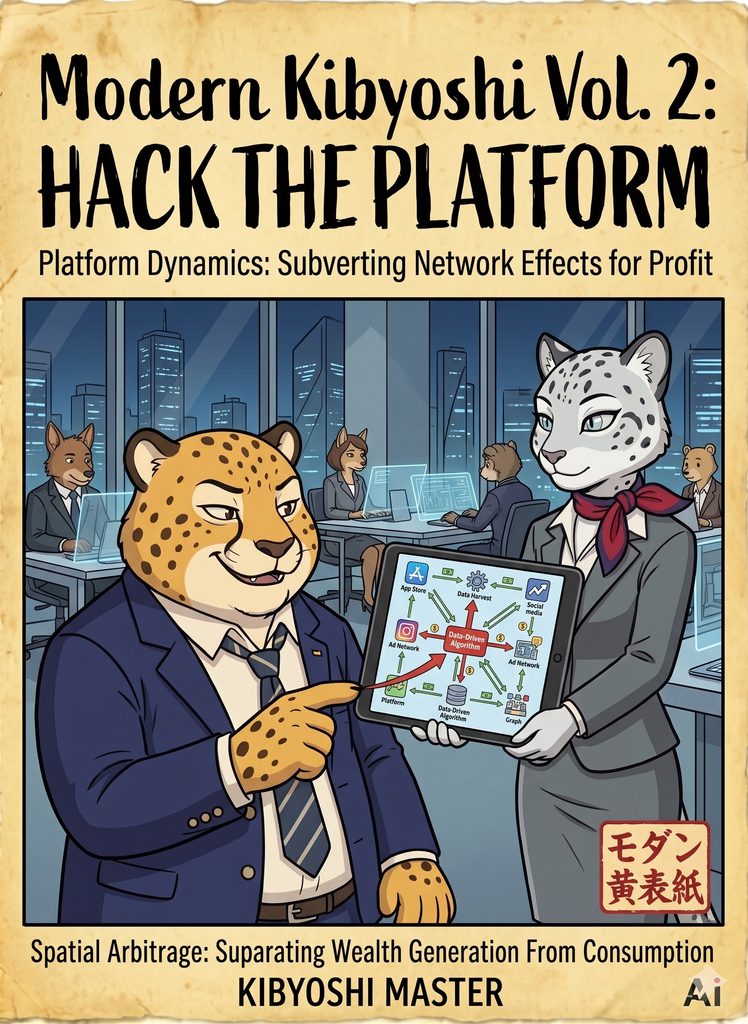
A behind-the-scenes look at the creation of the modern-day *Kibyoshi* series!
Introduction
We are currently standing at a major turning point in history: the definitive end of the "traditional salaryman era."
"(Return on Capital > Economic Growth Rate)". Faced with this cold mathematical reality, continuing to rely solely on a corporate salary is nothing but a "losing battle" where the outcome is obvious from the start. The old system, where simply getting a job guaranteed lifelong security and employment until pension age, has come to an end.
To survive such an era and show the path to breaking out from a "corporate-based employee" to an "autonomous asset owner," I will publish "Modern Kibyoshi Vol. 2" (entirely in English) on September 5th.
This work is a completely new business and lifestyle survival guide that fuses the chic, playful spirit of "Kibyoshi"—satirical comic books from the Edo period—with cutting-edge AI strategies.
1. Why "Kibyoshi"? — Erasing the Wrinkles Between Your Eyebrows and Remembering to Be Playful
Kibyoshi is a type of "Kusazoshi" (illustrated storybook) for adults that became hugely popular in the late Edo period (Anei to Bunka eras). It features a unique style where the entire page is filled with illustrations and text is written in the margins, skillfully weaving together humor, comicality, and social satire.
The reason I chose this style is that I want to live a playfully "reckless" life—in a good sense—until the very end, keeping a "playful spirit" just like Tsutaya Juzaburo, the media king of the Edo period, and Santo Kyoden, the master of Kibyoshi.
During my time as a corporate employee, I was constantly stressed, and the wrinkles between my eyebrows never disappeared. However, I simply cannot believe that desperately living a serious life with a perpetual frown is the only "right answer." Rather, life works out better when you tackle it with a child-like mindset, enjoying the process with a comfortable margin of 60 to 70 percent effort. Do not take things too seriously; instead, find the fun in redefining the "requirements" of your life plan. "Kibyoshi" was the optimal medium to express this.
2. Surviving the Savannah of Capitalism — The Story of Cheeta and Rachel
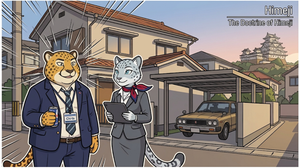
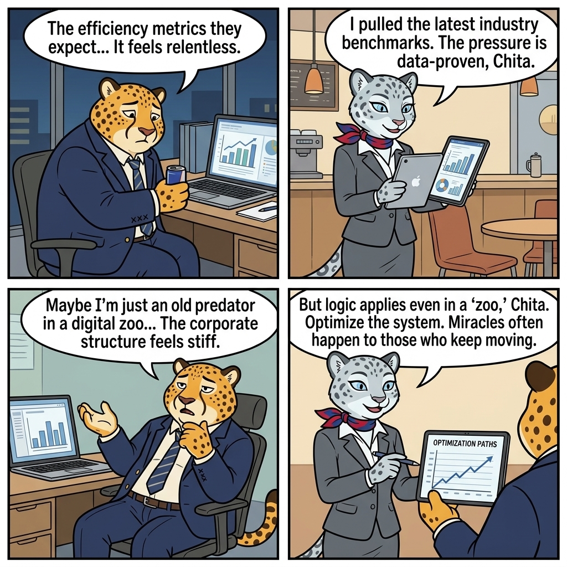
In this book, the story unfolds through comic characters to make the seemingly daunting themes of investing and wealth building feel more accessible. The protagonist is Cheeta, a logistics company employee in his 30s, exhausted and bound by corporate society. Guiding him is a wealthy snow leopard: Rachel, a cool-headed, sharp strategic advisor and a friend from his student days.
Cheeta symbolizes exactly "who I used to be." He is utterly exhausted from avoiding making waves in the organization, trying to "be liked" by others, and living by "someone else's standards." When you depend entirely on a salary, you are forced to bend your own beliefs just to survive. The school system does not teach us "how to survive outside the company." As you age, your options for changing jobs narrow, and adapting to change becomes increasingly difficult.
Because discussions about investing and money are directly tied to our lives, making decisions is difficult, and they are sometimes shunned as "suspicious." In reality, investment scams never cease. If it were just a hobby, you could easily say, "If it doesn't work out, I'll just quit," but when your livelihood is on the line, it is not that simple. That is exactly why I want readers to borrow Rachel's intelligence and experience the process of rewriting their own "internal OS (basic thinking system)" alongside Cheeta.
📘Modern Kibyoshi Series Now on sale!
3. A Historical Turning Point and a New Worldview
The modern social structure is beginning to heavily distort.
❶ The Distortion of Capitalism:Shareholders > Employees
As demonstrated by French economist Thomas Piketty's "Return on Capital > Economic Growth Rate" , the relationship between corporations and individuals has fundamentally changed. A position dependent on a salary is mathematically disadvantageous; we are in an era where you must move to the "asset-owning side" rather than just getting a job. This signifies a transition from "Path 1 (Worker)" to "Path 3 (Capitalist/Investor)." For details 👉Only 3 "Winning Routes" in the Game of Life: The Hidden Rulebook of Capitalism
❷ The Rise of AI: From Knowledge to "Practice and Ecosystem"
With the evolution of AI, mere "book-smarts" are losing their value, and white-collar jobs are rapidly being replaced. In the coming era, the strongest individuals are those who take action themselves and grasp "primary information" from the field.
A pyramid-style bureaucracy, where self-worth is measured by how many subordinates you have, no longer functions. Entrepreneurs prefer flat organizations without taking on fixed costs (risks). The future belongs to an "era of ecosystems" driven by independent individuals, AI working 24 hours a day (Caesar's legions), and the seamless networks connecting them.
4. Overview of "Modern Kibyoshi Vol. 2" (Table of Contents)
In this book, you can experience the adventures of Cheeta and Rachel as they travel across Japan through the following five chapters.

Chapter 1: AI Workshop Utilizing generative
AI as the "ultimate digital employee" to build an autonomously running organization with 60 to 70 percent effort.
Chapter 2: The Blueprint of Wealth
Learned from History Reviving the wisdom of "horizontal division of labor" from Kyoto's Sanjusangendo Temple in the modern age to build an "AIO (AI-Optimized) Capture System."
Chapter 3: Global Cash Flow
Learning from 12th-century maritime trade to hack the pyramid structure and rewrite it into a wealth-generating OS.
Chapter 4: The Secrets of the Digital Pipeline
Shedding the illusion of "corporate titles" based on spatial lessons from Roppongi Hills, and shifting your stance from a consumer to the "owner of foundational assets."
Chapter 5: Crisis Management
Learning from the miraculous survival history of Akasaka Hikawa Shrine to build a solid portfolio foundation that remains unshaken by any market crash.
5. Conclusion: Step Down from the Spectator Seats and Live a Life Where You Are the Protagonist!
It is time to stop endlessly watching other people's matches from the spectator seats.
By multiplying the unique "experiences" you have cultivated with the latest "AI tools" fitting the times, you can knock on the door to independence with less risk than before. Do not wait for a trigger to act; act first. Improve and refine as you go. Whether it is entrance exams, getting a job, or changing careers, life is a gamble that you cannot escape from, no matter how far you go. We have shifted from an era where surviving within an organization was safe, to an era where you should truly enjoy your own "life."

▪Disclaimer
The information provided on this blog is for educational and informational purposes only and does not constitute professional financial or investment advice. We do not provide third-party asset management or individual management services. Please make investment decisions at your own risk.
© 2026 Julius.inc / Kibyoshi Project. All Rights Reserved.
"This character and setting are the intellectual property of Julius Inc., based on its own doctrine."
■Author Profile
About the Author Kenji Kamioka
AFP (Certified by the Japan Association for Financial Planners), Licensed Real Estate Transaction Specialist
President and CEO of Julius Co., Ltd.An investor and media owner with over 10 years of business management experience in Asian countries: Thailand, and Vietnam. While actively managing real estate and financial assets through his own company, he promotes a lifestyle that leverages the structure of capitalism. He has authored numerous books.
Please click here for a list of my publications 👉Amazon.com: KENJI KAMIOKA: books, biography, latest update
▶ [Click here for author profile details.]
▶ [See the list of works here]