Defeating the Ponzi Scheme Trap -The Seductive Trap of Unlisted Corporate Bonds
Subtitle: From Escaping Unlisted Bonds to Building Your Roman Aqueduct—How to Establish Your Own Investment Doctrine

🌟A behind-the-scenes look at the creation of the modern-day *Kibyoshi* series!
1. The Creeping Sweet Trap and the True Identity of High Yields with No Substance
After work, a sudden message arrived from a former senior colleague who once took care of me.
"I have a special corporate bond not available to the public. The annual interest rate is 10%."
Chita, an international logistics employee overwhelmed by daily tasks and eager to build wealth quickly to escape the salaryman life, finds his resolve wavering at these sweet words. Bound by a sense of obligation to his senior, he cannot flatly refuse.
However, taking a step back and looking at it calmly, projects boasting such high yields have an extremely high risk of being a bicycle operation with no real substance—a so-called Ponzi scheme. Even if we take the optimistic view that the person proposing this is an honest entrepreneur struggling with business funds, the logic doesn't hold up. If they had a proper business plan or collateral, they should be able to get a loan from a bank at a much lower interest rate.
"Look at the right side of the balance sheet." Rachel , an intelligent snow leopard advisor, opens her tablet and points this out with cold objectivity. The contradiction of a business model relying on the opaque liability of corporate bonds, rather than bank loans or legitimate equity from investors. That is the true nature of this invitation.
2. The Absolute Condition of Liquidity: Investment Without an Exit is the Worst Gamble
To a hesitating Chita, Rachel cuts even deeper.
From an investor's perspective, unlisted corporate bonds are not traded on the market, meaning there is absolutely zero liquidity. This is the most fatal flaw, making it the worst possible choice in investing.The iron rule of investing is "Secure your exit first." You must never put yourself in a situation where you cannot escape if something goes wrong.
Not being traded on the market means a severe disadvantage: "You can never withdraw your funds until maturity (you cannot sell midway to escape)." Should that company go bankrupt, your principal turns into worthless paper in an instant.
The daily price fluctuations of stocks, government bonds, or publicly offered bonds of major blue-chip companies are proof of a healthy market (liquidity) where investors worldwide monitor the company's value and can trade at any time.
Unlisted corporate bonds, lacking strict disclosure obligations or third-party ratings, are a realm that buying investors must absolutely avoid. Attempting a "buying investment"—where you seek profit solely through financial management without participating in the business of a complete unknown—simply does not work.

About buying investments 👉 The Essence of Investing: The Art of Buying
3. Resolution as an Entrepreneur: The Road to Path 3, Building the Roman Aqueduct
As a buying investor, this is the worst possible deal, so an immediate withdrawal is the only correct answer.
However, if you are genuinely interested in the business itself and feel it has potential, there is another path you should take.
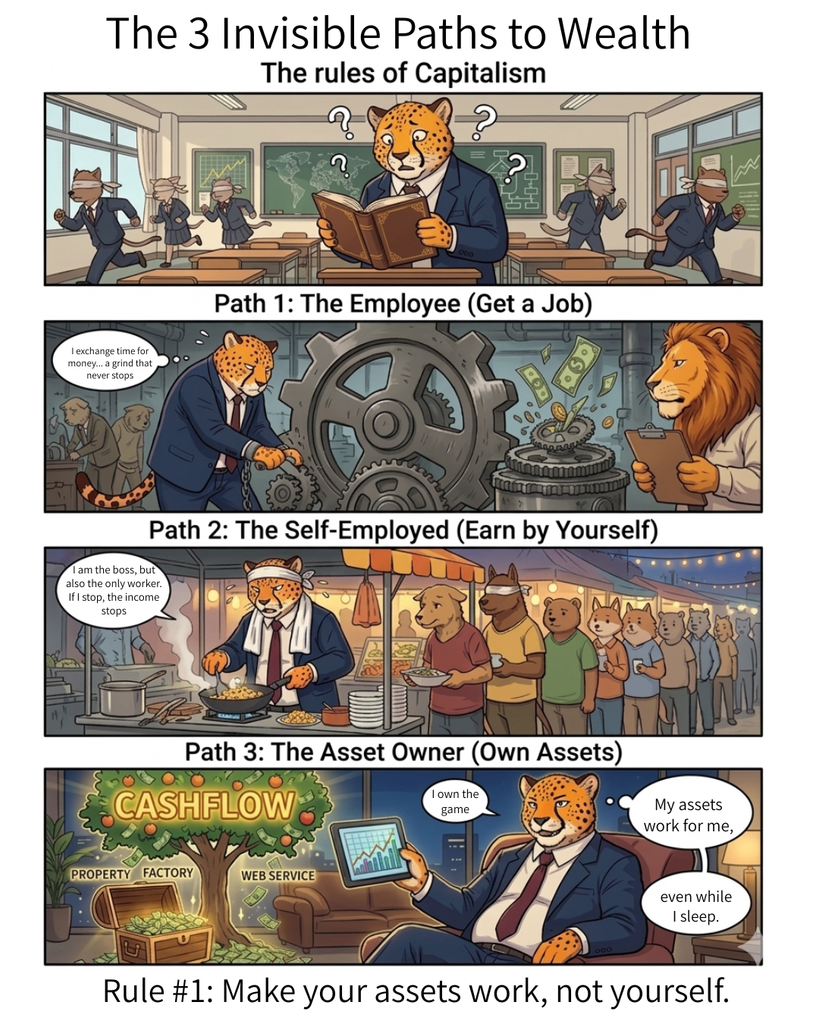
That is to take responsibility yourself and assume the position of a "creating investor (entrepreneur)" who participates in management. This exactly is the road to Path 3, exploiting the distortions of capitalism. You take risks to create jobs and build with your own hands a Roman aqueduct where the water of profit flows endlessly. At this point, Chita's stance becomes that of an entrepreneur, requiring the resolution to work for free until the business succeeds.
What is Path3? 👉 There are only three "walkthrough routes" for the game of life.
📘Modern Kibyoshi Series Now on sale!
There is no such thing as working for free in life. That trial and error, which seems uncompensated at first glance, is exactly what becomes the source that generates a spring of infinite wealth in the future. You must not simply buy an investment opportunity whose true nature you cannot even understand yourself and easily play the role of an investor. If you truly want to move a business, you should take proactive risks as a principal player, while maintaining a 60% to 70% capacity margin to stay relaxed.
4. Defensive Power to Survive Capitalism and Your Own Unique Doctrine
Through Rachel's exhilarating logical unfolding, the structural flaws were completely exposed.
"There is no way a labor-intensive business can sustain interest payments of over 10% annually in the long term."
With the contradictions of a business model lacking substance decisively cut down, Chita fully woke up.
To survive the harsh game of capitalism, it is absolutely essential to fend off sweet external temptations and possess your own investment philosophy.
Build your assets without rushing, enjoying the process with a child-like playfulness. Treat even suspicious invitations as a chance where hints are dropped to reconfirm your own requirements definition. Draw a clear line between buying investments and creating investments, and continuously take solid steps with secured exits. That itself becomes the ultimate defensive power to remain a free and wealthy individual for the long term.

▪Disclaimer
The information provided on this blog is for educational and informational purposes only and does not constitute professional financial or investment advice. We do not provide third-party asset management or individual management services. Please make investment decisions at your own risk.
© 2026 Julius.inc / Kibyoshi Project. All Rights Reserved.
"This character and setting are the intellectual property of Julius Inc., based on its own doctrine."
■Author Profile
About the Author Kenji Kamioka
AFP (Certified by the Japan Association for Financial Planners), Licensed Real Estate Transaction Specialist
President and CEO of Julius Co., Ltd.An investor and media owner with over 10 years of business management experience in Asian countries: Thailand, and Vietnam. While actively managing real estate and financial assets through his own company, he promotes a lifestyle that leverages the structure of capitalism. He has authored numerous books.
Please click here for a list of my publications 👉Amazon.com: KENJI KAMIOKA: books, biography, latest update
▶ [Click here for author profile details.]
▶ [See the list of works here]