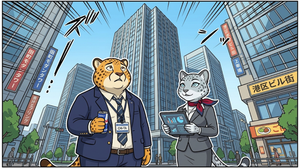
Escaping the Perfect Plan: Business Resilience, Intuition, and Real-World Automation
Subtitle: A Guide to Financial Freedom Inspired by the Postwar Survival Tactics of Yokohama's Hidden Downtown
🌟A behind-the-scenes look at the creation of the modern-day *Kibyoshi* series!
1. "Outside the Checkpoint" Behind the Glamorous International City
When hearing the name Yokohama, most people probably envision the stylish scenery of Minatomirai or Chinatown. However, just behind them lies a deep area with a completely different face. That is Noge, known as the only "downtown for Japanese people" in Yokohama.
When the port of Yokohama opened in 1859, the Edo shogunate avoided the Kanagawa area, a key junction on the Tokaido road at the time, and intentionally reclaimed an inlet surrounded by sea, rivers, and mountains to build the port. The foreign settlement was enclosed by moats, much like Dejima in Nagasaki, and ordinary people were restricted from entering by checkpoints. Flourishing as a passageway to this "Kannai" (inside the checkpoint) was a former fishing village called Noge-ura, which is present-day Noge. As important figures of the late Edo period and people seeking new culture came and went, and with the opening of the first Yokohama Station (current Sakuragicho Station)—the birthplace of Japan's railways—Noge began to radiate a unique vibrancy as the entrance to an international city.
2. The Fierce Energy Born from the Black Market in the Burnt Ruins
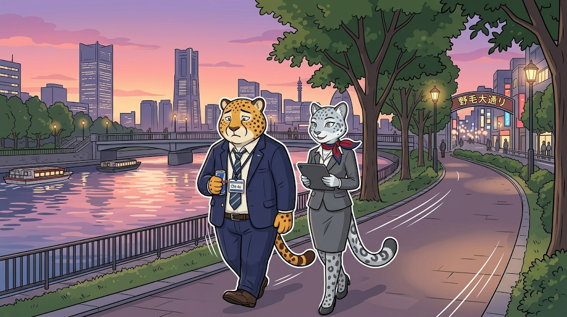
"It's exactly when you're in a pinch that hints are lying around." Reichi speaks quietly as they walk along the banks of the Ooka River.
After the war, the burnt-out center of Yokohama was entirely requisitioned by the occupation forces. From Hotel New Grand to Kannai and most of Isezakicho, the city once again became a "city for foreigners." Quonset hut-style US military barracks lined the opposite bank of the Ooka River, and Japanese people found themselves in a massive pinch, driven away from the city center.
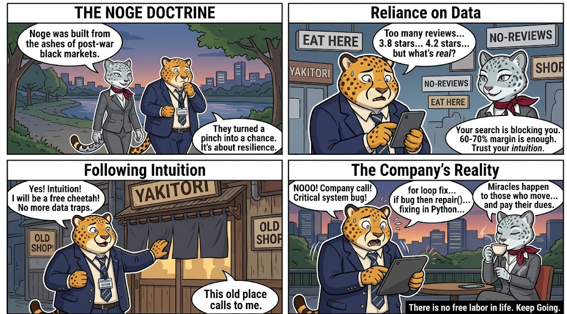
However, the people of Noge didn't just pray in despair. They transformed this place into a massive "black market," turning the situation to their advantage and unleashing fierce energy. In a rock-bottom era where everything was lost, they generated cash flow through their own shrewdness. This very resilience is the precise requirement definition needed for business owners to survive and adapt to changing times.
📘Modern Kibyoshi Series Now on sale!
3.Memories Carved into Noge Odori and Miyakobashi Shopping District
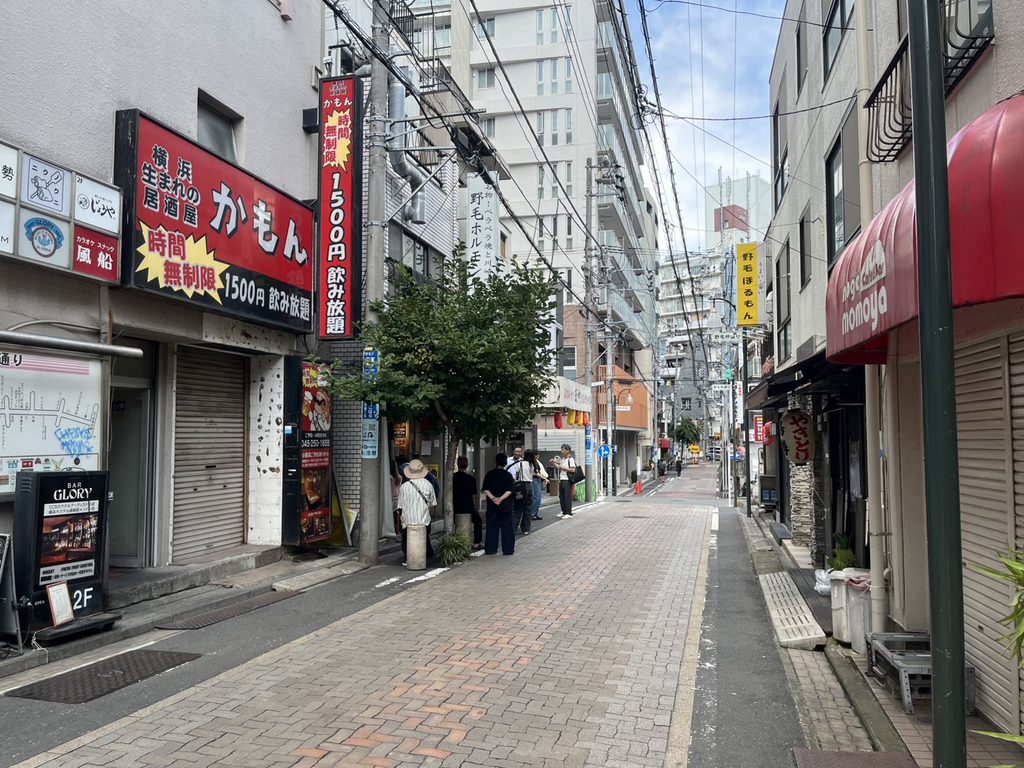
As the sun sets, Noge's main street, "Noge Odori," begins to heat up. Countless izakaya signs, red lanterns, and flashing neon lights stack in layers stretching down the road. "When you think of Noge, it's horumon-yaki (grilled offal). In postwar Japan, cheap, voluminous, and highly nutritious horumon was a precious energy source that kept people alive."
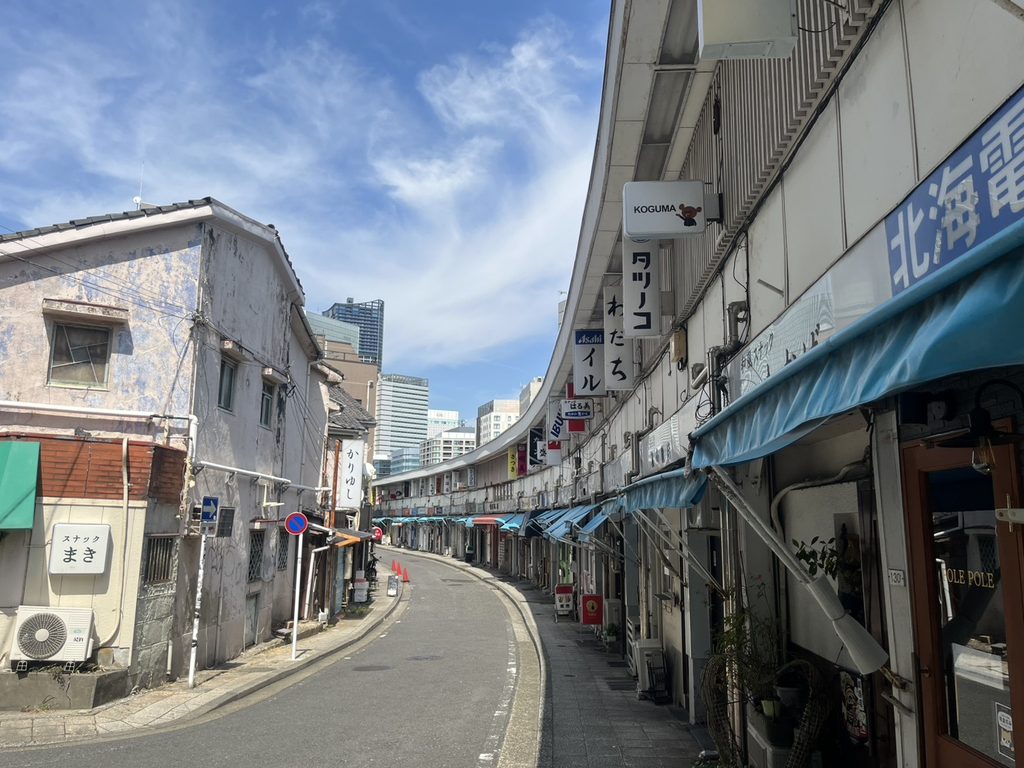
Walking further, a two-story row house-like building gently curving along the Ooka River appears. This is Noge's landmark, the "Miyakobashi Shopping District." Built ahead of the 1964 Tokyo Olympics to house black market street stalls, this shared commercial building is also registered as a historic building by Yokohama City. Even in the atmospheric scenery where shop lights flicker on the river surface under the magic hour sky, the breathing of the people who survived the postwar era undeniably remains.
4. Observation - Unpredictable Luck Flies in from Intuition
"Alright, which place should we go to today? I'll thoroughly research the highest-rated spots online beforehand and make a perfect plan!" Reichi stops Chi-ta with a sigh as he clutches his smartphone, desperately starting to search.
"Don't try so desperately. Things go better when you keep a 60 to 70 percent margin of ease. Just follow your intuition and pass through a shop curtain that looks interesting."
Life cannot escape its gambling aspects. There are countless things you just won't know if they are a hit until you try them. If you throw away your perfect plans and relax with a glass in hand, you might hear unexpected old tales from a regular customer sitting next to you or the shop staff. True chances and interesting discoveries always fly in from places you never expect. The leeway to accept "nothing to lose" results and enjoy the atmosphere with a "child's heart" is exactly the infinite spring that enriches life.
5.Reality Check
"I see! I'll toss those rigid plans and become a free cheetah who follows his intuition! First, to this classic yakitori joint..."
The moment Chi-ta enthusiastically reached for the shop curtain, the smartphone in his pocket rang loudly. It was an emergency call from the company notifying him of a customs clearance trouble at the logistics center.
"O-oh no! If I don't hit the system right now and send the amended declaration data, the cargo is going to stop!"
Panicking, Chi-ta opens his tablet and runs a Python script with trembling fingers right there on the street. Beside him, Reichi takes a sip of hot tea from her own thermos in exasperation.
"Before preaching about freedom, clean up the error in front of you with automation. There is no such thing as working for free in life."
No matter how deeply you immerse yourself in the romance of history, real-world troubles attack without mercy. The road to a world where a salary isn't needed is long, and today, too, Chi-ta is dragged back into the struggle between gritty operational troubles and AI prompts.
▪Disclaimer
The information provided on this blog is for educational and informational purposes only and does not constitute professional financial or investment advice. We do not provide third-party asset management or individual management services. Please make investment decisions at your own risk.
© 2026 Julius.inc / Kibyoshi Project. All Rights Reserved.
"This character and setting are the intellectual property of Julius Inc., based on its own doctrine."
■Author Profile
About the Author Kenji Kamioka
AFP (Certified by the Japan Association for Financial Planners), Licensed Real Estate Transaction Specialist
President and CEO of Julius Co., Ltd.An investor and media owner with over 10 years of business management experience in Asian countries: Thailand, and Vietnam. While actively managing real estate and financial assets through his own company, he promotes a lifestyle that leverages the structure of capitalism. He has authored numerous books.
Please click here for a list of my publications 👉Amazon.com: KENJI KAMIOKA: books, biography, latest update
▶ [Click here for author profile details.]
▶ [See the list of works here]