The Blueprint for Supreme Power Sleeping in the Kishu Clan Ruins: Yoshimune’s "Requirements Definition" That Surpassed Owari, and the Modern Wealth Doctrine
Subtitle: Designing Unshakeable Wealth: What a Shogun's Masterplan Teaches Modern Investors

🌟A behind-the-scenes look at the creation of the modern-day *Kibyoshi* series!
1. The Memory of Prime Real Estate Hidden Behind an Underwhelming Landmark
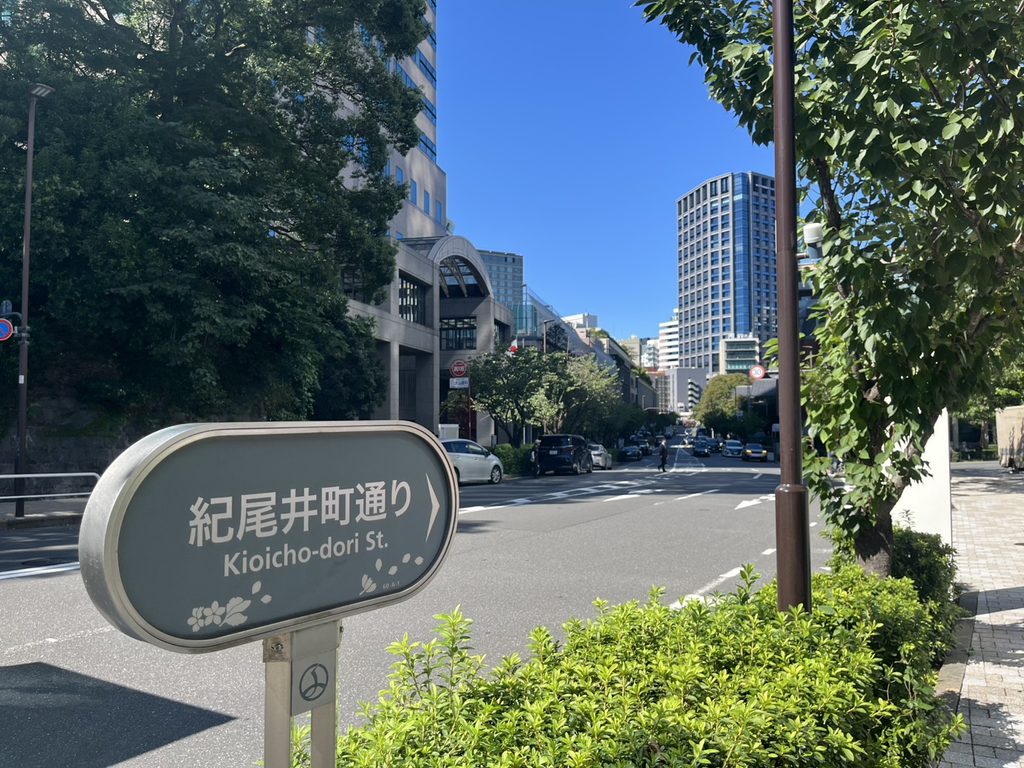
Stepping off at Akasaka-mitsuke Station on the Ginza subway line, you cross the Benkei Bridge and climb the slope toward Kioizaka for just a few minutes.
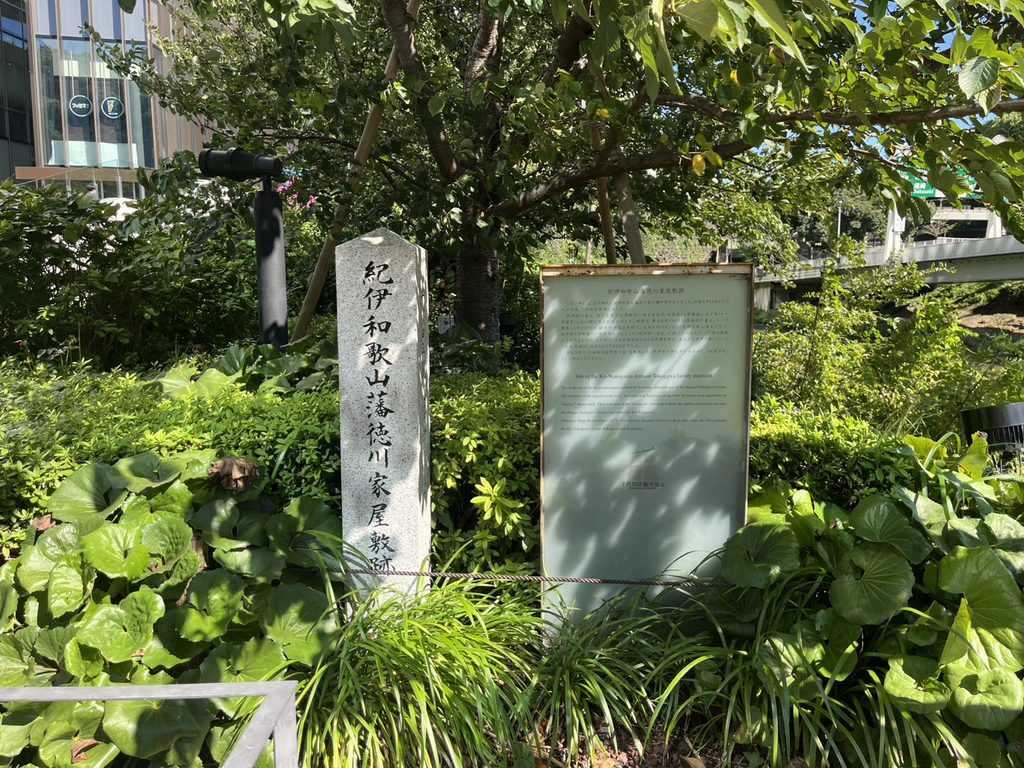
Tucked quietly among the green shrubs, a single stone monument appears: "Site of the Tokugawa Family Residence of the Kii Wakayama Domain."
To be frank, unless you are actively looking for it, you will almost certainly walk straight past it—it bears the modest, understated presence typical of historical site hopping.
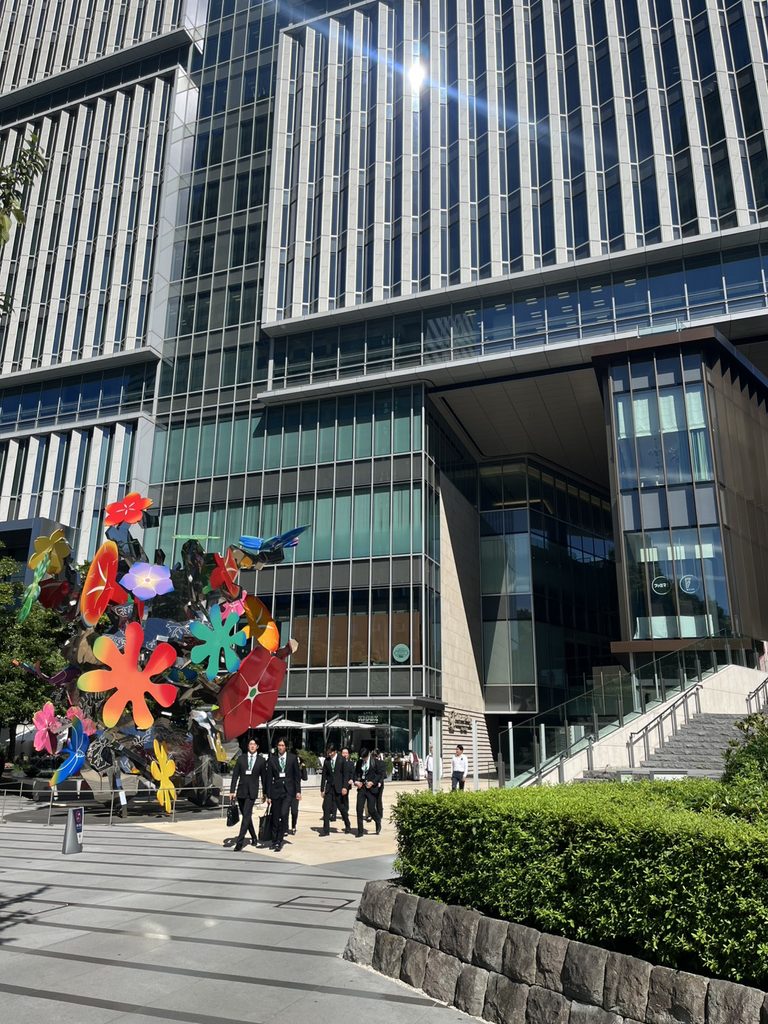
Looking up, the grounds of this former primary feudal estate have transformed into modern skyscrapers and sophisticated commercial complexes, pulsing as a central hub of modern capitalism.
Chita, the potbellied corporate worker, gasps for breath while staring up at the glass-paneled towers.
"It’s a bit anticlimactic for such prime real estate to have just a single stone marker. Besides, walking this steep incline between Akasaka-mitsuke and Kioicho is exhausting enough on its own." Rachel, having climbed the slope with an unbothered expression, quietly points it out while taking a sip from her tumbler.
"If you are simply disappointed by the small size of the stone monument, you won't be able to see the true nature of the city. This area is called 'Kioicho.' It is a compound name formed from the initial characters of Kishu Tokugawa, Owari Tokugawa, and the Ii clan of Hikone. Famous daimyo lined up their massive estates on this strategic high ground protecting the western side of Edo Castle. Above all, the Kishu Tokugawa clan was the family that surpassed Owari—the head of the Three Branch Families—and seized full control of the shogunate."
2. The Perpetual Motion Engine Called "Gosankyo" That Mastered the Superior Owari
The "Gosanke" (Three Branch Families) system established by Tokugawa Ieyasu served as a safety mechanism to resupply bloodlines if the main ruling dynasty died out. In terms of both rice yield (kokudaka) and family status, the Owari Tokugawa clan ranked first, while the Kishu Tokugawa clan held the second seat.
Yet, by an irony of history, Owari never produced a single shogun, whereas Kishu produced two Seii Taishogun: the 8th shogun Yoshimune and the 14th shogun Iemochi. From Yoshimune onward, the shogunal house was effectively monopolized by Kishu lineage.
Why was the second-ranked Kishu clan able to continue holding supreme national power?
The core reason lies in the 8th shogun Yoshimune’s outstanding "requirements definition" and "institutional design."
During his tenure as lord of Kishu, Yoshimune brilliantly revived a domain that had been on the verge of financial bankruptcy through thorough fiscal austerity, land reclamation, and industrial promotion. Arriving at Edo Castle with that track record and carrying out the famed "Kyoho Reforms" is well known. However, Yoshimune’s true genius did not lie merely in the reforms themselves, but in creating a "mechanism" to permanently reproduce his own bloodline.
That was the creation of the "Gosankyo" (Tayasu, Hitotsubashi, and Shimizu).
Yoshimune established houses for his own sons, integrating dedicated lineages within the castle grounds to supply heirs. Rather than relying on the existing external framework of the Gosanke, he laid an internal infrastructure—an aqueduct—inside Edo Castle to continuously supply his own bloodline. Through this robust ecosystem, the Kishu lineage continued to reign over the center of the shogunate until the Meiji Restoration.
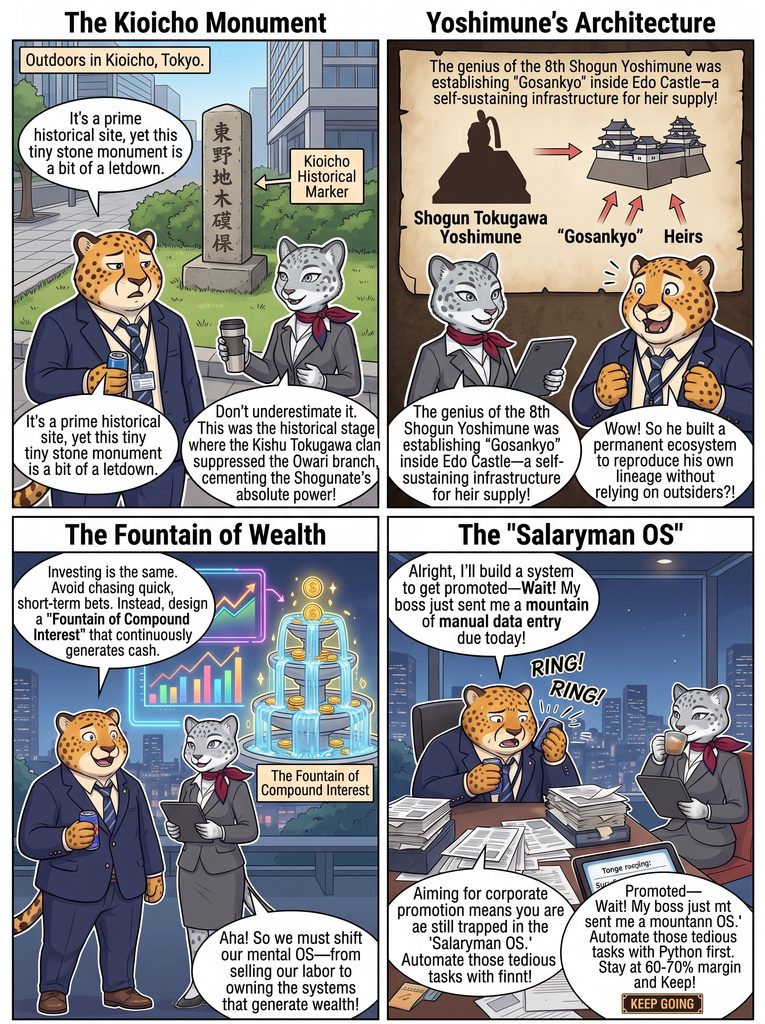
🎬 Go Deeper: Enjoy the four-panel manga with Rachel & Chita
3. The Investor Doctrine Seen in History: Design a "Fountain of Compounding"
This path taken by the Kishu Tokugawa clan aligns perfectly with the doctrine of modern wealth builders and investors.
First is the principle of "horizontally expanding a model you already hold (proven success)."
Yoshimune got his hands dirty on the local stage of the Kishu domain and established a winning formula for fiscal recovery. Then, after assuming the shogunate, he scaled that battle-tested know-how directly into the administration of the shogunate. Investing works exactly the same way. You do not begin by scattering bets everywhere in excessive diversification. First, you build a track record in a small arena where you can win, and then you steadily roll that success model out horizontally into large-cap dividend stocks and foreign-currency assets—this is the shortest route to building an unshakeable foundation.
Second is the ironclad rule that "the winner is not the one chasing one-off speculative hits, but the one who owns the mechanism (the aqueduct)."
The general public expends and exhausts its energy constantly fretting over short-term price fluctuations and the gamble of capital gains. However, true assets are nothing less than "infrastructure that continuously deposits cash into your pocket." Just as Yoshimune established the heir-replenishing system of the Gosankyo, an investor must hold robust cash-flow-generating assets, continuously reinvesting the yields that spring forth to perpetuate the compounding cycle.
Corporate workers chained to existing rules and consumed by internal office competition remain forever on the exploited side of capitalism’s distortions as pointed out by Thomas Piketty. Just as the Kishu clan broke through the constraints of the existing Gosanke system to establish a brand-new framework, we must switch our operating system: move from the side that sells its labor piece by piece to the side that owns the system.
4. Systematization and Everyday Automation
"I see! Lord Yoshimune’s brilliance wasn't just climbing the corporate ladder—it was building an ecosystem where successors were automatically supplied! I should construct an unshakeable corporate system so work gets done without me, earn top evaluations, and race up the corporate fast track!" Chita enthusiastically punches the air among the skyscrapers.
At that exact moment, Chita’s smartphone rings shrilly.
On the screen is a mountain of manual data entry due by evening, along with a barrage of urgent reminder messages from his boss.
"Aaaargh! The operational data I was supposed to finish today is completely untouched! Forget climbing the corporate ladder—I’m locked into an all-night hell of manual overtime!"
Watching Chita panic with his head in his hands, Rachel lightly taps on her mobile device and speaks with a cool, composed tone. "The very fact that your goal is climbing the corporate ladder proves you are still trapped in the cage of the salaryman OS. If you want to build a mechanism like a daimyo, start by automating that gritty manual grunt work. Run a Python script right now and clear it out. In life, there is no such thing as free labor. Tackle it with sixty to seventy percent effort to keep your margin, and Keep Going."
▪Disclaimer
The information provided on this blog is for educational and informational purposes only and does not constitute professional financial or investment advice. We do not provide third-party asset management or individual management services. Please make investment decisions at your own risk.
© 2026 Julius.inc / Kibyoshi Project. All Rights Reserved.
"This character and setting are the intellectual property of Julius Inc., based on its own doctrine."
■Author Profile
About the Author Kenji Kamioka
AFP (Certified by the Japan Association for Financial Planners), Licensed Real Estate Transaction Specialist
President and CEO of Julius Co., Ltd.An investor and media owner with over 10 years of business management experience in Asian countries: Thailand, and Vietnam. While actively managing real estate and financial assets through his own company, he promotes a lifestyle that leverages the structure of capitalism. He has authored numerous books.
▶ [Click here for author profile details.]
▶ [See the list of works here]