Ho Chi Minh City, Vietnam: Capitalism Hacks Learned from Haggling at Ben Thanh Market: "On-the-Ground Doctrine" for Surviving the AI Era
Subtitle: How to build unshakeable wealth and automate manual work using Python, inspired by street-smart haggling in Vietnam’s Ben Thanh Market
Key Takeaways
• The "70% Composure" Edge: Desperation kills leverage. Whether haggling in Ben Thanh Market or navigating market volatility, asymmetry belongs to those who stay detached, embrace the friction, and leave margin on the table for the other side.
• Ground Truth Over Screen Truth: In an era where AI commoditizes clean answers, unscripted street-level friction is the only non-fungible asset. You cannot synthesize street smarts from an air-conditioned room.
• Automate the Grunt Work, Arbitrage the World: High-level philosophy means nothing if you are buried in spreadsheet entry. Real capital leverage starts with Python scripts and systems that buy back your time.

🌟Take a behind-the-scenes look at the modern Kibyoshi (illustrated satirical booklets)!
1. Seamless Travel with a Single Smartphone and an Invitation to a Market Where History Intersects
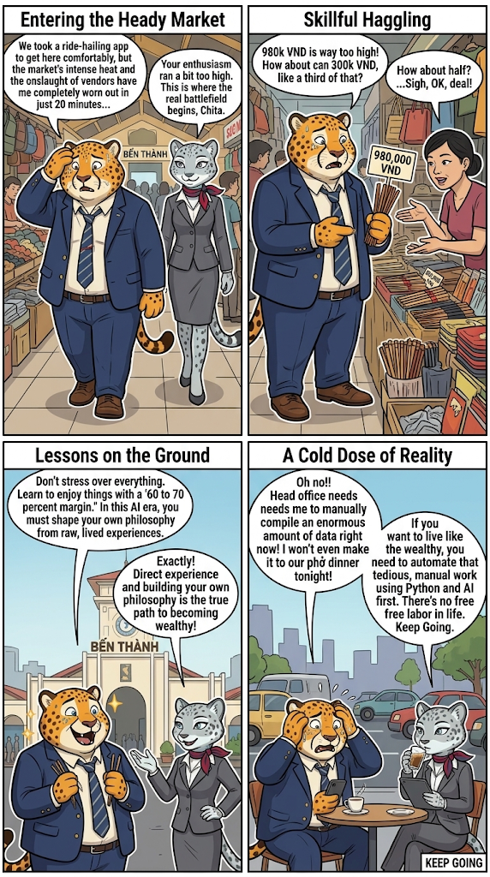
In the sweltering heat of Ho Chi Minh City, Chita and Rachel, a fellow seminar classmate from his university days, arranged a taxi from their hotel using a smartphone ride-hailing app.
Today, ride-hailing services are essential infrastructure for traveling in Southeast Asia. Unlike the old days, there is no need for troublesome price negotiations with drivers. Simply entering your destination into the app locks in the fare upfront, and the price remains unchanged even if you get caught in traffic. Because the driver's identity and ratings are visible, you are also freed from the exhaustion of staring at the meter on guard against rip-offs.
After spending a few dozen comfortable minutes in the air-conditioned car, Ho Chi Minh City's iconic "Ben Thanh Market" appeared right before their eyes. Its history dates back to the 19th century, and after surviving the ravages of war during the French colonial era, it was rebuilt at its current location in 1914. Over 2,000 stalls are packed tightly into the vast site of approximately 10,000 square meters, which still retains its European architectural style. More than just a tourist attraction, this place is closely tied to the daily lives of local shoppers and holds a unique charm where historical background and modern living culture intersect.

2. A Steamy, Entirely Different Game: The Price Tag is Merely the "Starting Line for Negotiation"
Stepping through the market entrance, an indescribable heat envelops your entire body.
"Whoa, let's do this!" Chita says, pumping himself up with mysterious enthusiasm, while beside him Rachel maintains her cool, unbothered expression.
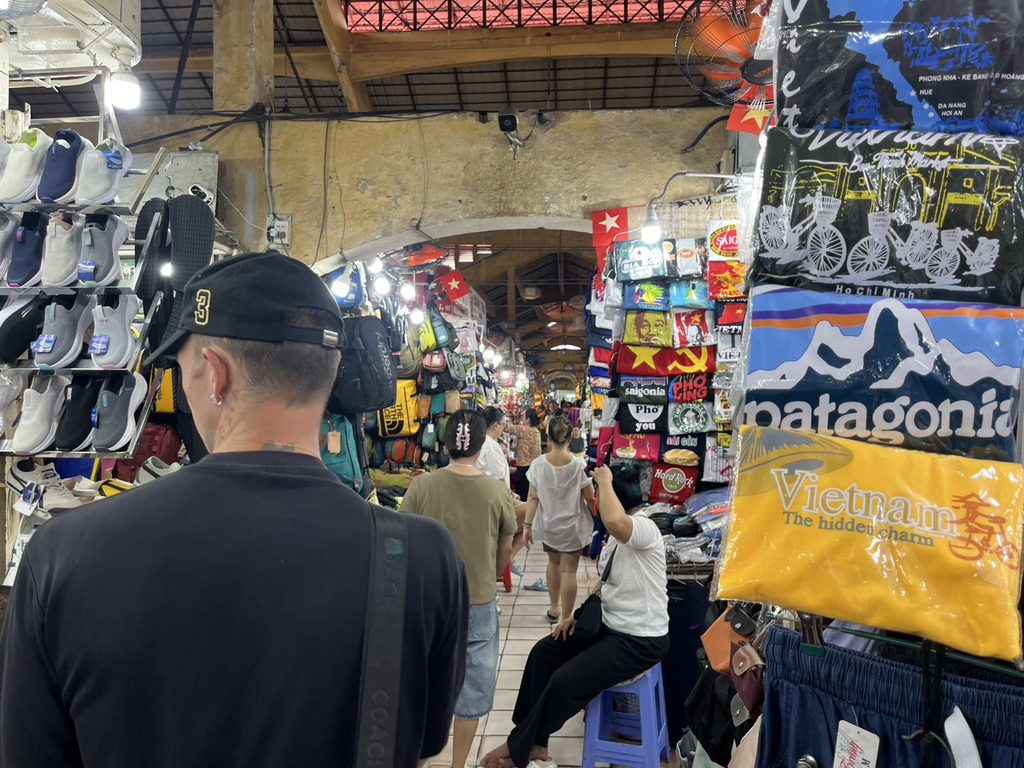
The aisles are crammed with everything from fresh ingredients to clothing and uniquely Vietnamese miscellaneous goods. Right next to the display shelves, shopkeepers sit nonchalantly on plastic chairs eating their meals. This is true Asia—the quintessential landscape of Vietnam. However, buffeted by the fierce heat, the crowds, and a relentless storm of touts, Chita was already completely exhausted after walking for just 20 minutes.
He managed to find some souvenir chopsticks and checked the price tag, which read "980,000 VND." You must not shop here the way you do in Japan. Earlier, local staff had advised him, "At Ben Thanh Market, start negotiating at one-third of the price. If you act like you're walking away, they'll cave." It resembles the kind of deal-making where a certain country's president bluffs with "100% tariffs!" Compared to buying at fixed prices in Japan, it feels like playing an entirely different sport.
"The price is too high." When Chita made a sour face, the middle-aged saleswoman pressed him, "How about half?" Chita immediately countered, "How about 300,000 VND?" After a moment of silence, the woman nodded firmly and said, "OK." The negotiation was a splendid success.
📘 Read the full story for FREE on Kindle+! Explore the complete story on Amazon.
3. True Assets Created by Firsthand On-the-Ground Information and "60–70% Composure" "Yes!
I successfully haggled it down!" To the rejoicing Chita, Rachel speaks quietly.
"This gritty haggling is by no means just a shopping trick. Chita, this connects to the universal law of 'not being desperate, and operating with 60 to 70 percent composure.'"
Desperation is strictly forbidden in negotiations. Rather than panicking that you "must buy it cheap no matter what," having the mental composure to enjoy the game is what produces results. Furthermore, if you hold the "four-way win" spirit that leaves a profit for the other party as well, the deal proceeds even more smoothly. This has the exact same structure as the mindset in asset management of patiently nurturing income gains without rushing and waiting for a market crash (a crisis) as an opportunity.
"We now live in an era where AI can instantly spit out right answers and mere knowledge. That is precisely why you need to step out of your air-conditioned room and visit the actual site overflowing with heat and hustle. Hone your flexible adaptability through friction on the ground and raw, firsthand experiences, and from there, forge your own unique 'philosophy (doctrine).' In the AI era where knowledge has become commoditized, this is the way for humans to survive, and it becomes a one-of-a-kind asset that no one can take away from you."
4. Modern Kibyoshi Punchline: Reality Check
"I see! Hands-on, firsthand experience and a unique philosophy really are the path to becoming a billionaire!"
Amidst the heat of Ben Thanh Market, Chita nodded deeply at Rachel's teachings, his eyes shining. However, right after that, the smartphone in his pocket rang loudly. Looking at the screen, he saw an urgent expense settlement issue from the head office in Japan and a reminder notification for an approaching data entry deadline.
"What!? They want me to compile this massive amount of data manually right now!? Forget becoming a billionaire—at this rate, I won't even be able to go eat pho tonight!" Chita cried, clutching his head.
Beside him, gracefully tilting her glass of Vietnamese coffee, Rachel delivered a cold remark.
"If you want to become a billionaire, start by automating that gritty manual labor. Run a Python script right now and make the AI process it. There is no such thing as working for free in life. Keep Going."
🎬 Continue the Journey
Dive deeper into the unapologetic doctrines of Asian capitalism, wealth architecture, and asset sovereignty through the satirical visual editions featuring Rachel & Chita.
▪Disclaimer
The information provided on this blog is for educational and informational purposes only and does not constitute professional financial or investment advice. We do not provide third-party asset management or individual management services. Please make investment decisions at your own risk.
© 2026 Julius.inc / Kibyoshi Project. All Rights Reserved.
"This character and setting are the intellectual property of Julius Inc., based on its own doctrine."
■Author Profile
About the Author Kenji Kamioka
AFP (Certified by the Japan Association for Financial Planners), Licensed Real Estate Transaction Specialist
President and CEO of Julius Co., Ltd.An investor and media owner with over 10 years of business management experience in Asian countries: Thailand, and Vietnam. While actively managing real estate and financial assets through his own company, he promotes a lifestyle that leverages the structure of capitalism. He has authored numerous books.
▶ [Click here for author profile details.]
▶ [See the list of works here]
