The $10 Million AI Logistics Revolution Behind "Quitting Bankruptcies"—The "Only Seat" We Should Choose in an Era Where IT Departments and Middle Management Vanish
Subtitle: From the Total Organizational Polarization Exposed by Cutting-Edge U.S. Databases and Generative AI to the Capitalism Hack of Living as a Business Owner and Shareholder
Key Takeaways
• The Market Weeds Out Mediocrity, Not Shortages:
"Quitting bankruptcies" are not the byproduct of scarce labor, but the inevitable purge of organizations that relied on person-dependent friction over scalable systemization.
• The Death of Corporate Insulation and the Middle Tier:
As autonomous AI agents flatten enterprise hierarchies—directly linking operational front lines to final capital allocators—the coordination-heavy middle manager and the legacy SIer are facing structural extinction.
• Capital Always Captures the Dividend:
Competing against compute on silicon's home turf is a fool's errand; the true asymmetric advantage belongs not to the salaried laborer running the workflows, but to the asset owners who deploy AI as frictionless leverage.

🌟Take a behind-the-scenes look at the modern Kibyoshi (illustrated satirical booklets)!
1. An Italian Restaurant in Omotesando and the Dissonance of "Quitting Bankruptcies"
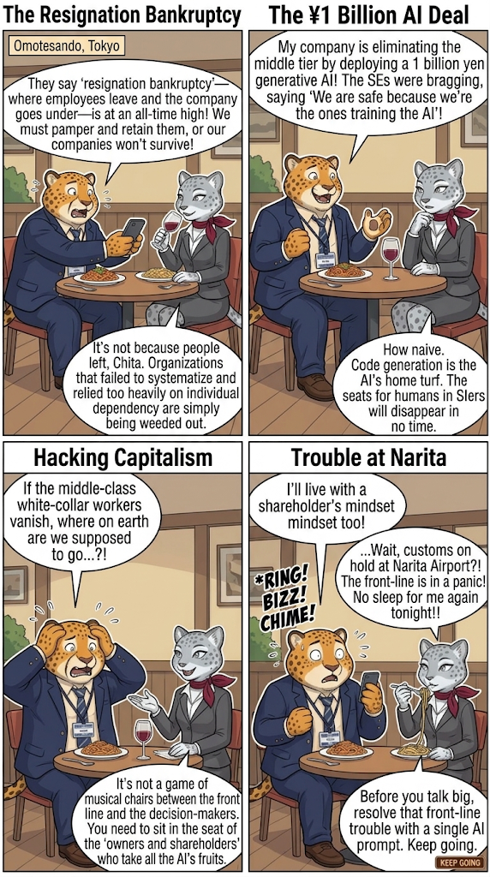
Tucked down a quiet back alley just off the Omotesando intersection sits a cozy Italian restaurant Chita has frequented since his college days. Inside, amid the savory aroma of garlic and porcini mushrooms, Chita sat before a steaming plate of pasta and held out his smartphone with a clammy hand. Sitting across from him, calmly tilting a wine glass, was Rachel—a former university seminar classmate who now lives a life of effortless financial freedom.
Flashing across the screen Chita showed her was the headline: "Quitting Bankruptcies Hit a Record High—The Era When Employees Resign and Companies Collapse." Working in the international logistics division of Japan's largest freight forwarder, Chita let out a bleak sigh, weighed down by his grueling daily workload.
"To think a company can go bankrupt just because people quit... labor shortages have gotten terrifying. I guess companies really can't survive anymore unless they desperately hold onto employees and lock them in with generous perks."
Rachel narrowed her ice-blue eyes and gave a small, exasperated shake of her head.
"Still getting spooked by surface-level numbers, I see. Those companies didn't collapse because people quit. Organizations that neglected to systematize their operations and coasted on person-dependent routine work are simply being ruthlessly weeded out by the market. ...More importantly, Chita, how did that pitch meeting go this afternoon?"
2. A $10 Million Deal Without the IT Department and SEs Who "Raise Agents"
At Rachel's words, Chita set down his fork and leaned forward. Earlier that day, Japan's largest system integrator (Company A) had visited Chita's international logistics division to pitch a complete overhaul of their internal logistics system.
"That's the thing—it was an astonishing meeting. The biggest anomaly was that our own IT department wasn't invited at all. Only the head of international logistics and those of us on the front lines sat in to hear the pitch directly."
What Company A brought to the table was a next-generation logistics operations platform powered by a cutting-edge U.S. database system and generative AI. The implementation cost ran to around $10 million (1 billion yen). At the core of the proposal was building a framework that directly connects "front-line operations" with the "final decision-maker," rendering all middle managers and report compilers in between completely obsolete.
"Company A's systems engineers were so full of themselves. They said, 'Our job today is to raise AI as autonomous agents.' In the past, SEs used programming languages like COBOL to bridge humans and computers, but in today's no-code world, programmers' jobs are already gone. From here on out, AI agents will apparently converse directly with clients and automatically handle everything from requirements definition to development and testing. They say Company A is raking in unprecedented profits from this integration capability. Major SIers sure look untouchable."
📘 Read the full story for FREE on Kindle+! Explore the complete story on Amazon.
3. Humans Cannot Win on the Computer's Turf—The Total Polarization of Organizations
As Chita spoke with a touch of awe, Rachel's cool gaze never wavered.
"What a naive little cheetah you are. Inside the virtual space of a computer, there is no way humans can beat computers. That is entirely their (AI's) home turf."
Rachel set her glass down and continued quietly.
"Company A's boasted $10 million integration windfall is nothing more than a fleeting firework. Generating code for data pipelines and system integration is the very domain where AI excels most. Within a few years, AI agents will complete the integration work itself in an instant. The seats of SIers relying on human-driven integration manpower will vanish in the blink of an eye, too."
What awaits beyond that is the cold, hard "total polarization" of corporations. The only two poles left inside an organization will be the "gritty front-line troops" moving physical cargo in the real world and the "decision-makers and executives" shouldered with final risk and investment calls. The middle-class white-collar workers who have spent their careers on internal coordination, progress tracking, and formatting data in Excel will see their roles physically evaporate.
On one side, small and mid-sized businesses are suffering "quitting bankruptcies" because they cannot retain staff; on the other, major corporations are spending $10 million to buy up systems that make human workers unnecessary. Both phenomena point to the exact same reality: the safe greenhouse where traditional salaried workers could comfortably sit back has ceased to exist.
4. The Capitalism Hack and Reality's Punchline
"If the middle tier disappears, where are the rest of us supposed to go...?!"
Clutching his head in despair, Chita was met by Rachel's graceful smile as she imparted the doctrine of capitalism.
"You don't join the cutthroat game of musical chairs between the front lines and the decision-makers. You step outside the structure—and take a seat as a 'business owner and shareholder.'"
As Piketty's inequality (r>g) exposed, no matter how much AI automates operations, slashes labor costs, and generates massive net profits, the spoils are not claimed by workers or SIers—they go solely to the owners and shareholders who hold capital. Break free from the labor market where everyone scrambles for the narcotic of a paycheck, put the ultimate employee—AI—to work for you, and move to the side that owns digital assets and equities. That is the one and only hack to turn the rules of capitalism in your favor.
"I get it...! I'll stop clinging to a paycheck too, and start living from the perspective of an owner and shareholder!"
The very instant Chita downed his wine in one gulp, his eyes gleaming with resolve, the company smartphone on the table rattled violently. Flashing across the screen was an urgent alert: "Customs hold on consolidated cargo at Narita Airport! Front-line panic breaking out!"
"Eek?! A customs crisis tonight of all nights?! Forget being an owner—I'm pulling another all-nighter tonight!"
Beside Chita as he turned pale and bolted upright, Rachel calmly twirled her pasta and delivered her parting shot.
"Before talking big, start by clearing up that front-line crisis with a single AI prompt. There's no such thing as a free ride in life. Keep going."
Flustered, Chita flipped open his tablet and began typing a troubleshooting prompt with trembling fingers.
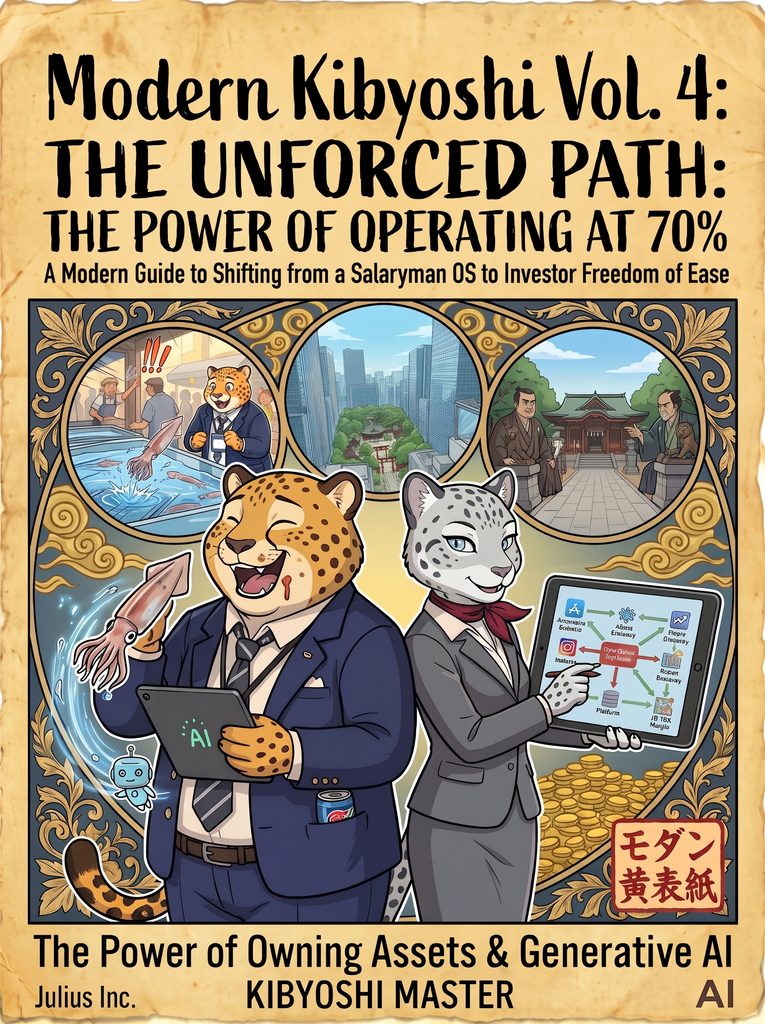
📘 New Release: Modern Kibyoshi Vol. 4 — The Unforced Path: The Power of Operating at 70%
Stop trading your life for a salary. Learn how to master primary information, automate the grind with AI, and build cash-flowing real assets alongside Chita and Rachel—all while operating at an effortless 70%.
▪Disclaimer
The information provided on this blog is for educational and informational purposes only and does not constitute professional financial or investment advice. We do not provide third-party asset management or individual management services. Please make investment decisions at your own risk.
© 2026 Julius.inc / Kibyoshi Project. All Rights Reserved.
"This character and setting are the intellectual property of Julius Inc., based on its own doctrine."
■Author Profile
About the Author Kenji Kamioka
AFP (Certified by the Japan Association for Financial Planners), Licensed Real Estate Transaction Specialist
President and CEO of Julius Co., Ltd.An investor and media owner with over 10 years of business management experience in Asian countries: Thailand, and Vietnam. While actively managing real estate and financial assets through his own company, he promotes a lifestyle that leverages the structure of capitalism. He has authored numerous books.
▶ [Click here for author profile details.]
▶ [See the list of works here]